By Ali Kassem, National University of Singapore
Morocco, a major country in the Arab Maghreb, has one of the largest higher education systems in the Arab region. Following independence in 1956, the Moroccan state undertook ambitious, multi-phase projects of ‘Arabisation’ and ‘Moroccanisation’ in which a developing and expanding public university system was central. The university here became a pillar of the post-colonial social contract and a key vehicle for social mobility. Simultaneously, especially through the National Union of Moroccan Students (UNEM), universities emerged as a sanctuary for the political contestation in which the wider country’s struggles were fought. That began to unravel in the 1980s and 90s as economic pressure and shifting geopolitics pushed the state toward neoliberal reforms and further interventionism that gradually challenged and limited public education’s reach and possibilities. Prestigious ‘public-private’ partnerships have been the most recent development within this timeline that have seen the emergence of American-style, extensively-resourced, and research-oriented universities that have been gaining significant prestige and traction as ‘innovative hubs’ and a desired model of North African and Arab higher education. Reflecting on a fieldwork trip to university campuses across Moroccan cities with a variety of Moroccan higher education institutions, this article identifies and problematises the contrast between the university as a contested public sanctuary and an emerging model of the university as a curated enclave. From there, the article raises the question of what is lost in/overwritten by this shift in the role of the university, and the implications for the politics, trajectory and identity of Morocco and its higher education system.
In December 2025, my research collaborator and I were travelling through Morocco as part of a preliminary trip on a project examining (de)coloniality and higher education in the Arab region. Moving between Fes and Marrakesh by train, Ben Guerir was one stop on the route. Arriving there, a notable number of young people disembarked. As I waited for the train to resume, I Googled the city and realized that it was the home of the much discussed Mohammed VI Polytechnic University (UM6P). Intrigued by its bold self-presentation as a leading public-private partnership reconfiguring the Moroccan higher education landscape, as well as by the significant media attention it received that I had previously encountered, we decided to pay UM6P a visit after our stay in Marrakesh.
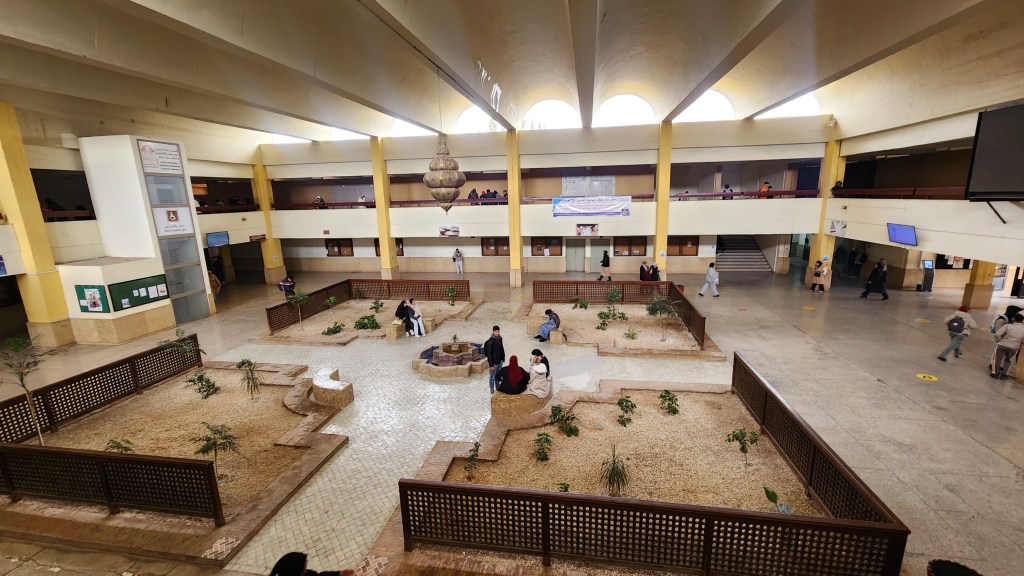
In Marrakesh and Fes, the weathered university campuses we visited displayed notable levels of messy, creative dwelling: small carts selling everything from counterfeit books to drinks and snacks, students socializing or sleeping on repurposed university infrastructure, student-run centres laden with leftist iconography and imagery, among a myriad of other formations characterised by constant movement and buzz. Consistently, albeit to varying extents, these campuses appeared as deeply political spaces of activism and, to a significant extent, spaces where a striking diversity of students could be seen: in socio-economic background, citizenship, linguistic choice, embodied performance, and political orientation. French and Darija (the Moroccan Arabic dialect) were the languages we encountered most, slippers and sportswear the dress choices, and walking in small groups the mode of transport. As we spoke with students, most articulated a fierce sense of ownership over the university’s physical and symbolic boundaries. Sitting in a largely makeshift campus café, we were approached by a student union representative who did not recognize us and hoped to recruit us to the union. This and other students spoke of political causes: of the prohibition on the military entering university campuses, of their right to negotiate and dictate what the university is and what it is for.
The institution here appeared porous, negotiated, co-created. Its ‘messiness’ is a powerful formation: a space thick with historical sediment, including that of UNEM — the student union whose pamphlets, billboards, and events were to be found everywhere — and the long-standing tradition of the campus as sanctuary for political contestation. It appeared occupied in a way that de facto defends it as a public commons against the looming pressures of structural adjustment, marketisation, Anglicisation, and corporatisation: from the dress codes indifferent to consumerist scripts to the layered diverse linguistic practices. Here, the university appeared to be a site of social formation where the contradictions of the Moroccan post-colonial state are lived and reworked. Throughout, heterogeneous students from disparate backgrounds could be seen claiming the space, converging into collectives mobilising around causes from class inequality to gender.
Against this backdrop, Ben Guerir represented a stark contrast; a rupture. UM6P is part of a ‘Green City’ project. It is a purpose-built environment where an expansive, affluent, manicured campus functions, I came to conclude, as a corporate enclave: looming glass facades, curated ecological landscaping, high-tech ‘smart’ classrooms with futuristic boards and lighting, even automated rubbish bins and robots. Alongside this, a pervasive ‘Anglicisation’ of the campus appeared to be a deliberate aesthetic and structural choice. Indeed, within as well as beyond classrooms and signage, there was little Darija to be heard, and little French. There were no slippers at UM6P. There was little walking either, with electric scooters dispersed around campus for students and faculty and electric buses patrolling the grounds. There were no makeshift shops, bootlegged books, or coffee sellers that we encountered in Fes and Marrakesh. There were rather highly curated university bookstores with portraits of tech entrepreneurs. Dedicated canteens sold everything from sushi to high-end burgers. There was no student union centre but rather a student center that resembled a tech-startup headquarters, with amenities ranging from bowling alleys to a cinema and pools. The student profile itself differed: racially, economically, in self-presentation. The activist student of Fes was here replaced by the fashionable entrepreneur who, when we spoke with them, consistently spoke of job markets and AI as key frontiers.
Here, the economic, social, and political contestation we saw in Fes and Marrakesh was absent, perhaps presumed irrelevant, or already resolved. Reminiscent of Marc Augé’s concept of the ‘non-place,’ Ben Guerir appeared to function as a site of transit and clinical efficiency: a space of ‘flow’ optimised for data, capital, and elite labour, whereas Fes and Marrakesh were spaces of ‘place’, thick with historical and social weight. With its performance of sustainability and its micromanaged rhythms, the campus seemed to signal a break from the ‘disorder’ of the public sphere into a capitalist drive for modern productivity, planted incongruously in Ben Guerir, a small, poor phosphate-mining town. It could exist just as easily in California or Qatar with little adjustment. The journey from Marrakesh to Ben Guerir town and then from town to campus, was in this sense a journey across formations, discrepant temporalities, and lifeworlds, where key social challenges, issues, and topics appeared obsolete or simply irrelevant.
This is, of course, one campus and one encounter in a country whose universities are far too varied to be reduced to a single contrast or a binary. Indeed, UM6P remains the exception rather than the norm in Morocco, and these institutions’ entanglements with capitalism, modernity, and nation-building deserve a more elaborate examination than a short piece such as this one allows. But similar forces to the ones shaping UM6P are reshaping higher education across the Arab region more broadly including privatisation, internationalisation, and the pursuit of an American-oriented ‘knowledge economy’. Over the past three decades, these have steadily displaced public universities as the default model in country after country. I therefore want to end where this essay began, with a specific question raised by this encountered contrast: what is the contemporary Arab university for, and what happens when it transforms into a ‘non-place’? What is lost when the student is transformed from a socio-political actor claiming ownership over their space into a consumer-entrepreneur navigating a top-down curated landscape? How can they engage, or fail to engage, the public issues of the broader nation as they inhabit spaces where such issues are silenced, aborted, or transcended? Higher education in the Arab region exists under a multitude of forces and crises including economic, political, ecological, and technological challenges, the emergence of AI among them. These forces foretell a future in which the messy sites of social transformation may be increasingly displaced by the sterile efficiency of so-called future-making enclaves, risking a profound decoupling of the university from the public sphere and a fundamental erosion of its transformative capacities as the states of the region pursue their developmentalist projects.
Dr Ali Kassem is a Lecturer in Sociology in the Department of Sociology and Anthropology at the National University of Singapore

