By Victoria Wahba, University of Oxford
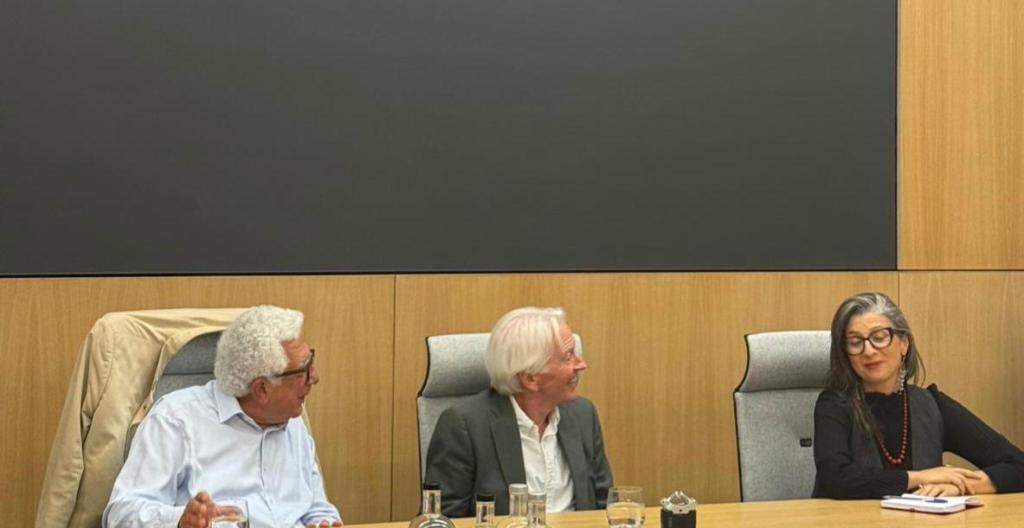
It is not every day that one experiences an event and knows immediately that they are witnessing history. It came about, however, that on 12th October 2026 the first event of the year for the Middle East Centre, I saw exactly that. Sat next to each other at Investcorp theatre at St. Antony’s College, were three individuals I have spent the latter half of my life considering the most eminent in their fields: Avi Shlaim, Francesca Albanese, and Eugene Rogan. It is with deep pleasure that I write from a non-negotiable call to action that the three greats imprinted upon me in the theatre. I attempt to fulfil that call.
Today there is a grim sort of din in our day-to-day lives. O Tempora O Mores means “Oh the times oh the morals.” Cicero used it in 63 BC, denouncing Catiline, who had plotted to overthrow the Republic and kill him. It is still used to lament moral decline. The news we hear on the radio in an Uber, on the television in an office, and from the notifications that pop up constantly throughout the day on our phone reflects this: a decay of civic duty and a world rife with death and destruction.
Often I feel this din makes it hard to hear hope and optimism, it fatigues the ears and dampens the spirit. Albanese broke through this fog with no notes, presentation or papers, and As I enter my second year in my MPhil degree, I have yet to see a crowd such as the one that filled the room of the lecture theatre. As Rogan tried to usher out the hundreds who could not find seats, Albanese joked that she had “never seen him be this bossy.” Rogan himself, who at all times carries a huge smile and chipper attitude, seemed in shock at the crowds who had lined up to see Albanese speak. Albanese was greeted with long applause, and the energy in the room built throughout the evening, ending in an even bigger ovation. I also write today for those who did not get to join us in that room.
To my left was Avi Shlaim, the Middle East Centre’s Iraqi-born Jewish Israeli-British historian, emeritus at Oxford after 38 years and author of Genocide in Gaza. In the middle sat Francesca Albanese, an international lawyer and, since May 2022, UN Special Rapporteur on the occupied Palestinian territories (her mandate was renewed in 2025). She co-wrote Palestinian Refugees in International Law, and her 2024 UN report Anatomy of a Genocide is one of her best known.”She was declared persona non grata by Israel in early 2024 and sanctioned by the US in July 2025. On my right, Eugene Rogan, the chair of the event, which opened the MEC’s 2026–27 programme, professor of Modern Middle Eastern History at Oxford, Director of the Middle East Centre and a Fellow of the British Academy, and one of the best-known historians of the modern Arab world.
The talk was a gripping discussion rather than a structured lecture, and all three spoke with passion and from the heart. The message Albanese most wanted her audience to hear was about courage and civic duty. She was not, she insisted, a courageous person: “It’s decency. It’s just decency.” She saves that word for those in the field who risk their lives to report on atrocities against Palestinians, and for those caught in what she likened to “the most macabre episodes of Hunger Games”, fighting for a bag of flour to feed their families while being shot at by Israeli soldiers. While many people claim humility by pointing to their supposed lack of courage, I wholeheartedly believe Albanese. She does not act out of courage; she acts as though there is no other choice. When I asked Shlaim about this afterwards, he disagreed: “There is no distinction [between courage and decency]. Francesca Albanese has both civic courage and humanity.”
Albanese and Shlaim come from very different backgrounds, yet both trace their sense of duty to an awareness of privilege. As an Italian, she acknowledged the shame she felt from the Holocaust when she was growing up and how it was a non-negotiable driver in her work. She is not Muslim, Middle Eastern, or directly affected by the Israel-Palestine conflict and yet she made it clear that if anything, that was even more reason for her to dedicate her work towards opposing such an atrocity. She acknowledged her extremely privileged position and articulated that as a result there was no other option than to leverage it towards positive change. For her, “never again” has to include Palestinians. She knows her privilege, and recognises a sense that she has to use it. Shlaim too wrote to me that “As a Jew, I feel I have a moral duty to stand by the Palestinians. For me to be Jewish means to support the underdog.” Privilege reveals itself in many ways, here we have two perspectives on how to recognise it.
From that privilege came a demand, aimed not at the students but at their professors. Albanese said we must “put a little bit of our comfort and private interest aside”, adding, “I’m talking especially… not to the students, to the professors, especially those with tenure.” It was a striking thing to hear in a room full of students: the call was aimed at the people teaching them. Shlaim agreed when I wrote to him: “I think that all academics have a duty to speak out against injustice, especially senior academics with tenure. I have been in Oxford for 38 years and I have enjoyed total freedom of speech on Israel/Palestine. Sadly, there has been an attack on freedom of speech, especially on this issue. Academics should have the courage of their convictions.” In a 2021 piece for Middle East Eye, Shlaim wrote that Oxford had “fixed its colours firmly to the fence”: it adopted the controversial IHRA definition of antisemitism under government pressure, but only as a loose guide, committing itself to neither side.
Albanese spent the two hours in the Investcorp theatre driving home a straightforward message that decency must be acted upon. Charming us with a rolling Italian accent and fiery inspiring words to match, Albanese hit the ground running on explaining her point of view. She was blunt in her words and quick to say that “legally, [Israel is] an apartheid state” that is part of “a system of exploitation and profiteering from death and destruction.” The audience heard no hesitancy in her voice either when she used the word “Israelisation” in reference to other countries, including th surveillance and drone technology at Lampedusa. In a 2025 UN report, she called this wider system an “economy of genocide”, in which states and companies profit from the war. She said plainly what many would be afraid to say, as if there were nothing else to say.
When I put my questions to Shlaim after the event, I started with a line from his 2023 defence of Albanese in Jadaliyya, where he called her work “a paradigm shift: the law should direct politics and not the other way round.” I asked whether international law had ever actually stopped a powerful state. His answer was one word, “Yes,” followed by a single example: the ICJ’s advisory opinion on Namibia, which, he wrote, “contributed to ending South African rule.” It’s a hopeful precedent, but also a sobering one. The opinion was issued in 1971 and Namibia didn’t become independent until 1990. I then asked how a historian writes about events that are still happening. Shlaim admitted he prefers the past, “we have more primary sources and we can see things in perspective,” but said that even with unfolding events “the historical context is all important.” In his latest book of essays, Genocide in Gaza, he tries to combine history with commentary on the present. Finally I asked whether their very different backgrounds shape how they come to the subject. He kept it short. “Personal background always influences one’s outlook and political stand,” he wrote. “Francesca is a passionate lawyer; I am a passionate historian. By different routes we reach almost identical conclusions on Israel/Palestine.”
To conclude, Shlaim wrote to me that, “students are always on the right side of history.” I write this article as a response to their call for civic duty, as a student who believes she is also on the right side of history, and for those who were not there to understand the affect their words had on one person who can start by sharing the aplomb she relayed in the room.
Victoria Wahba is an MPhil student in Modern Middle Eastern Studies at the University of Oxford’s St Antony’s College.
Francesca Albanese’s works can be found here and her reports can be found on the United Nations website. Albanese’s most recent report is Truth Under the Rubble: media in the time of genocide (9 October 2026). Avi Shlaim’s works referenced can be found here: Jaddaliya (2023) and Middle East Eye (2021).
Sources:
- Francesca Albanese in conversation with Avi Shlaim, chaired by Eugene Rogan. Middle East Centre, St Antony’s College, Oxford, 12 October 2026. Audio and transcript: https://www.podcasts.ox.ac.uk/francesca-albanese-un-special-rapporteur-occupied-palestinian-territories-conversation-avi-shlaim
- Avi Shlaim, written interview with the author, 4 November 2026.
- Avi Shlaim, “Oom-Shmoom: Israel’s Battle against the United Nations,” Jadaliyya, 7 July 2023. https://www.jadaliyya.com/Details/45189/Oom-Shmoom-Israel%E2%80%99s-Battle-against-the-United-Nations
- Avi Shlaim, “On British colonialism, antisemitism, and Palestinian rights,” Middle East Eye, 1 March 2021. https://www.middleeasteye.net/big-story/uk-palestine-israel-policy-balfour-johnson-anitsemitism-colonialism
- Francesca Albanese, Truth under the rubble: media in the time of genocide, report of the UN Special Rapporteur on the occupied Palestinian territory, October 2026. Reports: https://www.ohchr.org/en/special-procedures/sr-palestine

