By Zahra Alipour – Independent Iranian Commentator
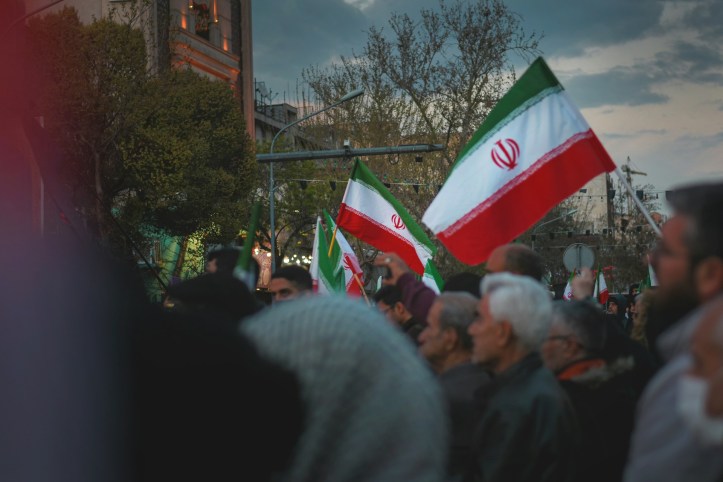
This piece has been written more than four months after January 8-9, when protesters were killed on the streets of Iran, and about three months after the Israel–U.S. attack on Iran. The information in this article is based on hours of long qualitative interviews with 945 residents of Tehran during two time periods: the January protests (two months before the Israel-U.S. attack on Iran) and during the bombing of Tehran during the Israel–U.S. attacks.
In January 2026, a group of social scientists and I conducted interviews with a group of Tehran residents about their predictions for the future of the January protests and whether they thought foreign military intervention could help the protesters. We asked the same question again during the war and found that their answers (especially from the third week onwards) had changed compared to January. We found that a significant portion of respondents had changed their perception of military intervention after witnessing the killing of civilians in the war and the threat to the country’s infrastructure. They made statements such as: “We saw firsthand on the street that Israeli attacks killed our children and civilian places and people”; “Their goal in the war is to exploit Iran economically, not to free us”; “With the way Israel is destroying infrastructure and disrupting our normal lives, we will need years to rebuild this country”; “Israel wants to take us back to 1941 and occupy our economic and political resources.”
For this study, random samples were selected with an emphasis on diversity in age, gender, and economic status (based on self-reported income). The findings cannot be generalized to the entire Iranian population, but the aim of this genealogy is to shed light on lesser-known intellectual groups. For this reason, we excluded groups that did not respond from the statistical sample. When selecting our interviewees, we tried to consider a variety of age groups, genders, professions, and economic backgrounds. From our conversations, we identified the following typologies of individuals:
- Supporters of Reza Pahlavi;
- Supporters of the Islamic Republic;
- Those who support Reza Pahlavi for the transitional period in the spirit of unity but don’t accept him as the ultimate representative;
- Those who support an internal solution with the agency of the Iranian people. They oppose foreign military intervention and the Pahlavi regime. They are critical of the Islamic Republic and are also disappointed with the change in the political order. (Perhaps something like the Green Iran Movement in 2009 is the closest example of this group.)
- Supporters of foreign military intervention who don’t necessarily support Reza Pahlavi and might even prefer a direct representative of the U.S. government.
This piece seeks to shed light on the plurality of ideas among Iranian protesters, not to assign relative weights to each point of view. But in this note, I will write about a subject that has received less attention and whose positioning among diverse and vocal discourses seems to be less heard. That is, the fourth group from the above division.
Background: The Days of the January 2026 Protests
Mohammad, a final-year sociology student at a university in Tehran, said, “I’m suspicious of Pahlavi; he is appropriating the protests.” Another interviewee, a 23-year-old woman working for a private company in east Tehran, said: “Pahlavi can fix the situation, like his father.” Ahmad, a 45-year-old physician, had a different idea: “We must somehow reach unity, and other than him, we have no alternative on the table!” A young woman in a café in north Tehran, who identified herself as belonging to a higher socioeconomic class, said: “If either one [an Israel/U.S. attack or Pahlavi’s return] happens, there will be chaos; the existing security is more important.” And there was another, more diverse group that did not necessarily wear the traditional Islamic Republic Hijab, but believed that the protests were reasonable and necessary at the beginning, but then a group of protesters infiltrated by Israeli spies was massacred in the streets. In a way, these people are supporters of the Islamic Republic.
There was another subgroup: those who were critical of the policies of the Islamic Republic and who believed that neither military intervention nor Pahlavi could lead Iran to their ideal model of governance: “We think that we should work more on building social institutions. Neither the current situation nor a foreign savior is our ideal model.” Livelihood issues and some government policies were the most common areas of protest for this group. This group saw the protests as disconnected from “life” and the desire to live: they thought that these protests had strangely acquired a motive for death from the third and fourth day onward. This claim became more evident in their statements when they referred to the deaths of protesters in the streets. Some of them likened this type of protest, which seeks quick results, to fast food cooking. For this reason, they did not feel united with this group, neither on the street nor in ideas. They said that if they had been in the streets with the protesters in those days and had not shouted “Long live Pahlavi,” they would have been ostracized by the protesting crowd. They believed that joining such protests was wrong. This group, which is somewhat similar to what I would describe as “searching for an internal solution,” believes that an ideal government can be established in the long run, through nonviolent protest.
The “unity” group became suspicious of Reza Pahlavi’s intentions after he removed the slogan “Woman, Life, Freedom” (a slogan calling for the abolition of compulsory hijab, coined by Iranians after the death of Mahsa Amini) from his Instagram bio in the middle of the protests, and similarly on his “X” (formerly Twitter) account:
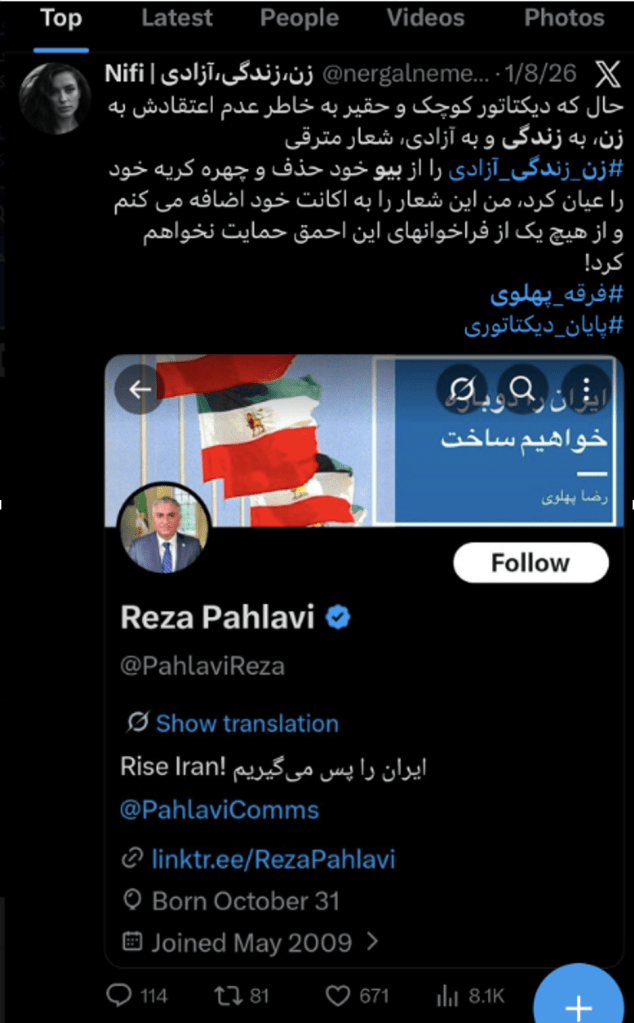
At the same time, sharp disagreements were forming on X in Iran between supporters of “Woman, Life, Freedom” and those of Reza Pahlavi. These two political currents expressed exclusionary and negative attitudes toward each other in their comments on the protests. This pessimism was later intensified by Reza Pahlavi’s condolences for the deaths of American soldiers and his indifference to the deaths of Iranians.
So far, we have identified five distinct groups in this article:
| Group[1] | View of the Islamic Republic | View of Israel/U.S. as Saviors | View of Reza Pahlavi | Affirmative Vision |
| Supporter of the Islamic Republic | Supportive | Opposed | Opposed | Deep belief in the idea of combining Islam and governance |
| Internal solution | Opposed | Opposed | Opposed | Belief in strengthening institutions and nonviolent protest; willing to go to prison for their activism |
| “Unity” Group | Opposed | Opposed in principle, but aligned in practice | Opposed in principle, but aligned in practice | Sees no alternative; argues that aside from Pahlavi or foreign intervention, there is no representative or solution for national unity and the transitional period. |
| Supporter of Pahlavi | Opposed | Supportive, if it aligns with supporting Pahlavi. | Supportive | Sees Reza Pahlavi as the only option. |
| Supporter of foreign military intervention | Opposed | Supportive | Mixed opinions | Belief in foreign military intervention as savior, doesn’t necessarily support Reza Pahlavi. |
I will move on to the second part of the article and the days of war, focusing on the internal solution group.
Day 30 of the U.S.-Israel war on Iran in March 2026
After the 30th day of war and witnessing destruction and civilian deaths, interviewees displayed different perspectives compared to the January 2026 protests. From the first day of the war, they expressed different emotions: some were happy yet anxious about the future; some were afraid; and others were uncertain about what would come next.
Ali, a young employee in central Tehran, said: “Following up on the events of the war showed that Israel and the US have gone beyond what they initially announced. With this level of civilian casualties, I think with this level of bombing of Iran’s infrastructure and energy resources, they want to occupy the country.” Referring to this report and a foreign report on the first and perhaps experimental use of a new US missile, Mohammad said, “Maybe we are a laboratory for weapons of mass destruction and the idea of America and Israel saving Iran is a media hoax.” “They say Israel is warning us that they are bombing areas. Where can I go as a daily wage worker? The explosion doesn’t just damage a house. They know that attacking a house also affects the houses on the surrounding streets and alleys, and even the blast wave kills children and throws people out of their homes into the street and they die.” Mahdieh points to the deaths of babies in hospitals. Another person asks us in the middle of this conversation: “Why did the US and Israel attack Minab School twice?” She points to an interview and says that a US senator talks about the power of US missile cameras and that they actually saw flowers on the school wall. So why did they attack the school twice? Maryam, a 51-year-old woman who was forced to take leave by a contracting company, told us that her neighbor was killed in an explosion while she was doing her daily shopping in the street. Of course, some groups that had not yet been harmed and had gone to the northern or eastern provinces of Iran thought that this bombing could bring salvation, But as the days of war passed and the casualties approached their relatives and friends, they began to doubt their initial ideas and said that they were not only killing military personnel, but also ordinary people in their homes.
While aggregating the interviews conducted in January 2026 and on the 30th day of the war in March 2026, I observed that one political subject seems to be becoming more prominent: supporters of an internal solution (those who are most concerned with Iran itself, and therefore opposed simultaneously to Israel/U.S. and Pahlavi and critical of the Islamic Republic). It seems that Pahlavi’s comments about the December deaths and what they saw as his irresponsible calls for people to take to the streets, and on the other hand observing American and Israeli attacks on civilians, industrial and energy sites, and even works of art and antiquity, made them fear and reject foreign intervention.
A lesser-known political subject: the advocates of an internal solution, at the same time opposed to foreign military intervention and a transitional leader from abroad (Pahlavi) and a critic of the Islamic Republic and desperate for reform of the existing policy:
This type of political subject seems to be similar to those who are serving time in prison but are opposed to foreign intervention to save Iran. One example of this subject is Parastoo Forouhar, whose mother and father were killed in a series of murders. She comes to Iran every year to hold ceremonies for them. She is not popular with the Islamic Republic because she criticizes the country’s policies but also opposes a military attack. Zia Nabavi is another figure who spent many years in prison for participating in civil protests. He simultaneously condemns war and foreign intervention in his writings, while also criticizing the logic of domestic politics, but he is hopeful about the future. This type of political subject seems to be similar to those who are serving time in prison, but they do not see Pahlavi or foreign military intervention as a savior.
A clear example of this idea can be seen in the statement of 150 political prisoners. This group of current and former political prisoners, as well as those interrogated by the Islamic Republic’s security forces, who have themselves been victims of internal repression for years, issued a statement condemning any military aggression against Iran by the United States and Israel and emphasizing that their differences with the government have nothing to do with foreign aggressors and are in no way associated with war or violence. Another example is something like a form of protest, along with raising awareness and creating specialized vocabulary around the issue being protested, with the goal of long-term institutionalization and systemic change; much like what a trade commission in Iran’s digital economy is advancing through its Internet quality reports. The thinking of these types of groups shows that this group also opposes Pahlavi because of his lack of experience in Iran and what they see as his inadequate personal political record, saying that he is calling on people to take to the streets without understanding the situation in Iran and without feeling responsible for the deaths. At the same time, they criticize the Iranian government for its inefficiencies and for creating the current situation, while simultaneously despairing of political reform. They say that Iran could have done better in these years, adjusting its foreign policy to take greater advantage of the capabilities of the global market and, as a result, create better livelihoods and prosperity for its people. They use the same argument to reject foreign “saviors” like Israel and the United States, claiming that they want Iran to become like Iraq and Syria. When asked about their alternatives, they have no clear answer. They say that through generational change and people’s agency, the right answer to this situation is that we must pursue our desires through long-term institution-building and non-violence.
For one, they are concerned about American colonialism and express the belief that, ultimately, America is after Iranian oil and the destruction of the nation. This group feels similarly about Israel’s attack. In the past year, the United States and Israel have engaged in two wars that killed Iranian civilians, including children, doctors, and many other noncombatants. Therefore, they are skeptical of the narrative of Israel as “savior”. Mohsen, a final-year economics student, said: “Just as Pahlavi called defenseless people into the streets and did not take responsibility for those deaths, Israel and the U.S. also tell people to take to the streets during bombings while they are destroying the country’s defense structures, medical centers, and schools.” When asked what they would do if Pahlavi takes over power in Iran some day, one respondent said, “I would fight.”
Conclusion
This group sees the solution in serious domestic reforms through a council of the people. They seek to reorganize foreign relations and integrate Iran into the international political system. They want to resist colonial policies while opposing repressive and restrictive domestic policies, such as internet filtering and compulsory hijab, but also Iran’s foreign policy. The internet shutdown inside the country helped give Iranians abroad (those who were war-mongering) a more prominent opportunity to represent Iranian views on military intervention. The internal solution group wants Iran to gain access to international markets, but not through a foreign invasion of the country. In this sense, they seem to be positioned between the extremists who favor foreign intervention and support Pahlavi and the supporters of the Islamic Republic. They see themselves as a minority in the current situation, but the historical evidence of their participation in movements shows that they are part of a powerful discourse that is willing to bear high costs for Iran. Therefore, they oppose any military intervention, even if it is well-intentioned. Some, to clarify their position, said that there is no salvation in foreign military intervention and that foreign powers, under the pretext of saving the people, are seeking to leave the country defenseless and turn Iran into another Iraq.
Another noteworthy point is their views on foreign media. Interviewees said that a significant portion of the group of Iranians abroad who have a voice in foreign news agencies do not sufficiently address or understand the view that Iran will not be saved by bombing and, incidentally, are calling on Trump to attack Iran. For example, some interviewees had trouble with the proposition that Persian networks outside Iran, such as Iran International, were telling Iranians inside the country to take to the streets and protest during the bombing, even though these media outlets knew that civilians were being bombed. Others were angry that the media were urging Iranians to quit their jobs without regard for their daily lives, or that the media were “unrealistic” in portraying images of civilians being bombed and displaced from their homes. Based on these interviews, the media (and Iran International in particular) seem to have lost credibility among this group of Iranians seeking a domestic solution. “If we are going to be killed in Iran to liberate the country, why don’t Iran International employees come to Iran and get killed in the bombing with us?” they said. In fact, the group believed that the media were complementary to the bombing. Like the media, they said, Reza Pahlavi and the monarchist movement were profiting from the deaths of Iranians under bombing and were not taking responsibility for calling people to the streets. In conclusion, this article presents a collection of opinions from individuals in Iran who have expressed a wide range of views on the protests, the war, and the future of Iran. This article has attempted to highlight an underrepresented group of Iranians who are both critical of the Islamic Republic and frustrated with the reforms, and opposed to both foreign military intervention and the Pahlavi dynasty. Their positions should be considered by those seeking to build a new future for Iran.
[1] Due to the limited statistical population, this grouping cannot be expressed quantitatively and in terms of the share of each group in the total Iranian population. The genealogy of the groups aims to shed light on groups that are probably less well known.

