By Izzy Welsh, University of Pennsylvania
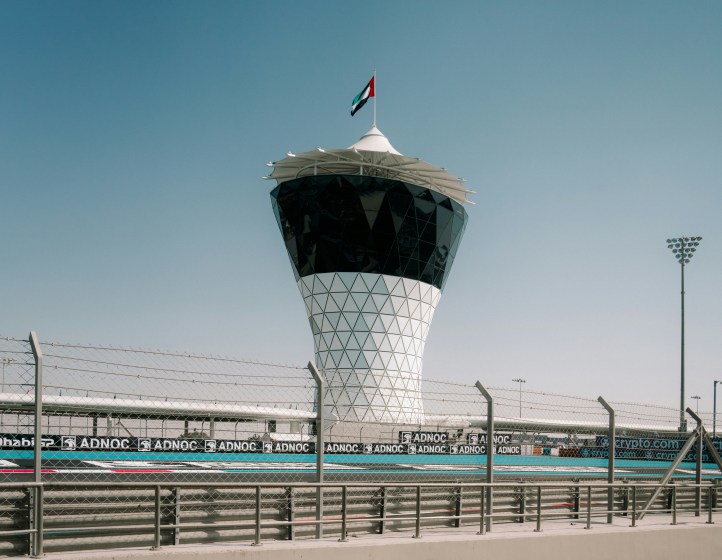
In August 2025, F1: The Movie (2025) drew $552 million at the global box office, becoming Apple’s highest-grossing film to date.[1] Equally revealing is how its star, Brad Pitt, and Director Joseph Kosinski publicly praised one of their shooting locations: Abu Dhabi.[2] Filmed over twenty-nine days at Yas Marina Circuit, the most expensive racetrack ever built, the production is the first to capture live Grand Prix footage.[3] In fact, the Abu Dhabi Grand Prix serves as the film’s climatic finale, encompassing forty-three minutes of a 155-minute runtime, and the only race included from the Middle East. To secure this final calendar spot and maximize viewership, the Abu Dhabi government pays a substantial premium to Formula One.[4] And, while Star Wars, Dune, Fast and Furious, and Mission Impossible all filmed there, why is the Abu Dhabi Film Commission (ADFC) hailing F1: The Movie as a “milestone” for the Emirate’s growing entertainment industry?[5] What does this distinction reveal about Abu Dhabi’s evolving strategy to amplify its soft power over Dubai and the five other principalities forming the United Arab Emirates (UAE)?
F1: The Movie marks a new mode of place branding for Abu Dhabi by harnessing the global reach of both Hollywood and Formula One to establish itself as the Gulf’s premier film production hub and in doing so, amplify its soft power. Where previous projects such as the Louvre Abu Dhabi and Guggenheim bolstered the Emirate’s soft power among global audiences by importing Western cultural institutions, this film exports Abu Dhabi’s mega-sport and production infrastructure, transforming spectators into virtual visitors. In doing so, it stages what political geographer Natalie Koch describes as the use of globalized sport to broadcast Gulf cities as “modern” and “places ripe for investment.”[6] While other Gulf film commissions advertise their F1 circuits as shooting locations such as the Jeddah Corniche Circuit in Saudi Arabia, Lusail International Circuit in Qatar, and Bahrain International Circuit, the ADFC is the only one thus far to successfully feature its Grand Prix in a major Hollywood production. This distinction signifies F1: The Movie not merely a film shot in Abu Dhabi but a vehicle through which Abu Dhabi advertises its investments in both Formula One and production infrastructure to global audiences.
Background
While Abu Dhabi holds most of the oil and gas reserves in the UAE, it is usually Dubai that is widely recognized as a tourism, trade, and investment hub. Abu Dhabi has advanced its economic diversification policies in recent years, but its place branding strategy diverges from Dubai’s through its heavier emphasis on cultural prestige. Where the ADFC prioritizes high-value productions from Western studios, Dubai specializes in high-speed, higher-volume commercial content geared towards regional markets, typically with less extensive financial support.[7][8] The ADFC, established in 2007, is in fact the only Emirati film commission to offer comprehensive production infrastructure: free scouting assistance, logistical support, professional crews, world-class soundstages, and post-production facilities.[9] Moreover, its generous 30% cash rebate program, introduced in 2015, returns 30% of eligible production costs for shoots that register with the Creative Media Authority (CMA), spend at least $200,000 USD, and use licensed local services and suppliers. In 2025, the CMA even raised the rebate percentage to 35%.[10] By treating cinema as both economic and cultural investment, the program generates what one observer calls a “snowball effect”: each production amplifying Abu Dhabi’s visibility and drawing new talent.[11] The Emirate also deploys globally recognized events—the Abu Dhabi HSBC Golf Championship and the UFC’s Abu Dhabi Showdown Week—to promote itself as a sporting destination and diversify its economy away from oil.[12] Hollywood film importantly extends this branding beyond sport’s seasonal audience and geographical limits, immortalizing it in public consciousness. Spectacle is the mechanism: places “have to be seen to be dynamic, progressive, modern… ‘global’ before actually becoming so economically.”[13]
F1: The Movie as Cinematic Place Branding
Abu Dhabi’s investment in iconic mega-sports locations such as Etihad Arena (which hosts the NBA and UFC) and Zayed Sports City (home to professional football and tennis matches) and its promotion of them as filming sites enacts what architect Richard Koeck argues: that architecture and urban form can be understood as a “cinematic apparatus.”[14] The F1 production filmed at both Yas Marina Circuit and twofour54 Studios, a state funded soundstage complex, in collaboration with the CMA and ADFC. It employed over 280 local crew members.[15] Sweeping overhead shots of the Circuit’s white latticed shell and illuminated geometric contours are interspersed throughout racing sequences.[16] As Anne Gombault and Didier Selles observed, the legitimizing role of branding is also achieved through architecture, a logic the film’s cinematography mirrors directly.[17] F1’s final race sequence further layers such visual arguments: the audience is taken inside the futuristic, high-tech garages that the Circuit boasts. Western cast members and Emirati men are seen mingling in the opulent Paddock Club.[18] An Etihad plane trails the colors of the UAE flag overhead.[19] The race’s awards ceremony was filmed immediately after the actual Grand Prix podium, underscoring the production’s intent to capture the actual Abu Dhabi Grand Prix, not simply reenact it at the Circuit. By blurring the boundary between fiction and documentary in this staging, the film confers a sense of authenticity and institutional legitimacy onto its own branding exercise. This effect is further reinforced through the inclusion of real F1 racers such as Lewis Hamilton (who also served as a producer), Max Verstappen, and Charles Leclerc, whose presence anchors the film in the actual ecosystem of the sport.[20] Formula One supplies the audience; in a fragmented media landscape, mega-sports remain among the few content forms capable of mass global viewership, making them as valuable to governments as to media companies.[21] The film deploys that audience on behalf of Abu Dhabi’s desired self-image as a world class production hub.[22]As Anholt argues, a “clear, credible, appealing, distinctive and thoroughly planned” place branding strategy will survive and prosper which F1: The Movie directly promotes on behalf of Abu Dhabi.[23]
Global Circulation, Local Buy-In, and Film Tourism
F1: The Movie opened in seventy-eight international markets, debuting #1 globally with $144 million gross and a 97% Rotten Tomatoes score, later surpassing $630 million after an IMAX re-release and earning four Academy Award nominations.[24] The ADFC’s own framing is instructive; their website quotes Kosinski calling it a “privilege to film in Abu Dhabi,” citing its stunning locations, substantial filming support, and warmth of the people, phrasing that positions the Emirate as a desirable production destination and a “world-class hub for cinematic storytelling.” [25] The film’s regional premiere at Yas Marina Circuit further amplified this brand: driving simulators, exclusive car displays, and partner watch showcases, immersed guests in both the film’s constructed world and Abu Dhabi itself.[26] Locally, the film earned $2.7 million in its UAE opening weekend, the biggest opening for an Apple film in the country.[27] As De Jong et al. note, place branding gains legitimacy through local stakeholder involvement, and Hollywood’s growing recalibration toward international audiences (who account for the majority of total box office gross) makes F1: The Movie the ideal instrument for reaching them.[28]
Tourism Strategy 2030 and the Future of Emirati Place Branding
F1: The Movie must be situated within Abu Dhabi’s Tourism Strategy 2030 which aims to position the Emirate as a “vibrant hub for culture and innovation.”[29] Unveiled in 2024, the plan outlines boosting visitor numbers to 39.3 million, AED 90 billion in sector GDP, and 178,000 new tourism jobs by 2030.[30] Incentivizing foreign film production more than other competing Emirates is one mechanism through which Abu Dhabi pursues these targets. The UAE’s own Vision 2031 states this logic explicitly: “the growth of cinema in the UAE not only reflects economic ambition but also a commitment to fostering storytelling, cultural expression, and cross-cultural dialogue.”[31] F1: The Movie thus embodies what Anholt calls tourism promotion at its most effective which involves selling a defined product to a defined audience to boost soft power.[32] The film achieves this by symbiotically amplifying Abu Dhabi’s elite sports and production infrastructure, inspiring future visitors and business opportunities.
Conclusion
F1: The Movie marks a significant evolution in Abu Dhabi’s place branding strategy through an innovative blending of global cinema and mega-sport. Rather than importing Western cultural prestige, the Emirate now exports its own sports and production environments to a global audience through the Hollywood apparatus, transforming them into virtual visitors. Moreover, Abu Dhabi harnesses Hollywood’s expertise in mass appeal and folds it into its own soft-power strategy. The film circulates an image of the Emirate as dynamic, technologically advanced, and embracing of international collaboration, all rooted in infrastructure that actually exists. As film and tourism stakeholders increasingly collaborate “with the dual goals of attracting film production and then capitalizing on the subsequent exposure,” Abu Dhabi positions itself not merely as a peripheral destination to Dubai but as a global one in its own right.[33] Ultimately, the success of F1: The Movie broadcasts Abu Dhabi’s modern image to a rapidly expanding audience worldwide, advancing the Emirate’s soft-power ambitions one frame at a time.
Izzy Welsh is an undergraduate student at the University of Pennsylvania. She holds a BA in English and Cinema Studies with a minor in Modern Middle Eastern Studies. Her academic work centers on the intersection of entertainment, geopolitics, and soft power in the contemporary Middle East. She works as an associate in international film distribution.
Bibliography
Abu Dhabi Film Commission. 2025. “Abu Dhabi Celebrates its Starring Role in F1: The Movie at Yas Marina Circuit.” July 2. https://www.film.gov.ae/media-centre/abu-dhabi-celebrates-its-starring-role-in-f1:-the-movie-at-yas-marina-circuit. Accessed October 2, 2025.
Abu Dhabi Film Commission. 2025. “Abu Dhabi Stages Regional Premiere of F1: The Movie on Bespoke Yas Marina Circuit Cinema.” June 26. https://www.film.gov.ae/media-centre/abu-dhabi-stages-regional-premiere-of-f1:-the-movie-on-bespoke-yas-marina-circuit-cinema. Accessed October 3, 2025.
Abu Dhabi Film Commission. 2025. “Yas Marina Circuit Makes Regional History with Blockbuster Premiere Event in Abu Dhabi,” August 5. https://www.film.gov.ae/media-centre/yas-marina-circuit-makes-regional-history-with-blockbuster-premiere-event-in-abu-dhabi. Accessed October 2, 2025.
Aburghif, Hsham. 2022. “UAE: Cultural Representation and Re-Creating Emirates Environment in International Films and its Implications for Tourism.” Journal of Arts, Literature, Humanities and Social Sciences 82: 197-207.
Anholt, Simon. 2004. “Place Branding: Has it all Been a Big Misunderstanding?” Place Branding and Public Diplomacy 20, no. Suppl 1: 4-6.
Anholt, Simon. 2005. “Some Important Distinctions in Place Branding.” Place Branding 1, no. 2: 116-121.
Box Office Mojo by IMDbPro. 2025. “F1: The Movie.” October 2. https://www.boxofficemojo.com/release/rl2507374593/. Accessed November 17, 2025.
Carter, Thomas F. 2011. “Interrogating Athletic Urbanism: On Examining the Politics of the City Underpinning the Production of the Spectacle.” International Review for the Sociology of Sport 46, no. 2: 131-139.
Chadwick, Simon, and Hans Erik Næss. 2023. Formula 1 in the Gulf Region. The Future of Motorsports: Business, Politics and Society. Vol. 1. Abingdon, Oxon: New York, NY: Routledge, p. 13 -23.
Creative Media Authority Abu Dhabi. 2024. “Abu Dhabi Unveils New Cashback Rebate Starting from 35%++ at MIPCOM 2024 to Further Boost Film and TV Production in the Capital.” October 22. https://www.cma.gov.ae/news/abu-dhabi-unveils-new-cashback-rebate-starting-from-35-at-mipcom-2024-to-further-boost-film-and-tv-production-in-the-capital-2#:~:text=The%20Abu%20Dhabi%20Film%20Commission%20(ADFC)%20is,individuals%20looking%20for%20training%20and%20internship%20opportunities. Accessed April 10, 2026.
Dhal, Sharmila. 2019. “Filming Permits in Dubai to be Issued in One Day.” Gulf News, January 7. https://gulfnews.com/uae/filming-permits-in-dubai-to-be-issued-in-one-day-1.61100952. Accessed April 22, 2026.
De Jong, Martin, Thomas Hoppe, and Negar Noori. 2019. “City Branding, Sustainable Urban Development and the Rentier State. How do Qatar, Abu Dhabi and Dubai Present Themselves in the Age of Post Oil and Global Warming?” Energies 12, no. 9: 1657, p. 1 – 26.
Gombault, Anne, and Didier Selles. 2018. “Company Profile: Louvre Abu Dhabi: A Radical Innovation, But What Future for French Cultural Influence?” International Journal of Arts Management: 83-94.
Koch, Natalie, Danyel Reiche, and Paul Michael Brannagan. 2022. “Sporting Cities and Economic Diversification in the Arabian Peninsula.” Routledge Handbook of Sport in the Middle East /. Vol. 1. Abingdon, Oxon: New York, NY: Routledge.
Koeck, Richard. 2013. Cine-Scapes: Cinematic Spaces in Architecture and Cities. New York: Routledge.
Koshy, Swapna, and Adarsh Anoop. 2016. “The Role of Fandom, Comic-Con and Films in Soft-Power Diplomacy of the UAE: An Exploratory Study.” University of Wollongong in Dubai – Papers: 3 – 7.
Kosinski, Joseph. 2025. F1: The Movie. Culver City, CA: Apple Studios, Jerry Bruckheimer Films, and Plan B Entertainment.
Levy, Giana. 2025. “‘F1’Rundown: Lewis Hamilton, Max Verstappen, and Every Formula One Racer in Brad Pitt’s Movie,” Variety, June 27. https://variety.com/lists/f1-movie-cast-real-drivers/. Accessed April 10, 2026.
Moreau, Jordan. 2025. “‘F1’ Returns to IMAX Theaters After Becoming Brad Pitt’s Highest-Grossing Movie Ever.” Variety, August 6. https://variety.com/2025/film/news/f1-imax-return-rerelease-tickets-1236480603/. Accessed October 27, 2025.
Reid, Caroline. 2025. “How Movies Have a Blockbuster Impact on Abu Dhabi’s Economy.” Forbes, November 12. https://www.forbes.com/sites/carolinereid/2025/11/12/how-movies-have-a-blockbuster-impact-on-abu-dhabis-economy/. Accessed April 22, 2026.
Saberi, Donya, Cody Morris Paris, and Belisa Marochi. 2018. “Soft Power and Place Branding in the United Arab Emirates: Examples of the Tourism and Film Industries.” International Journal of Diplomacy and Economy 4 (1): 44-58.
Skey, Michael. 2023. “Sportswashing: Media Headline or Analytic Concept?” International Review for the Sociology of Sport 58, no. 5: 749-764.
Sylt, Christian. 2017. “The $1 Billion Cost of Hosting an F1 Race.” Forbes, March 13.i https://www.forbes.com/sites/csylt/2017/03/13/the-1-billion-cost-of-hosting-an-f1-race/. Accessed April 2, 2026.
The Department of Culture and Tourism – Abu Dhabi. 2024. “Tourism Strategy 2030.” April 4. https://dct.gov.ae/en/who.we.are/tourism.strategy.2030.aspx. Accessed November 13, 2025.
United Arab Emirates Ministry of Economy and Tourism. 2024. “We the Emirates 2031.” December 30. https://www.moet.gov.ae/en/future-economy#:~:text=%E2%80%9CWe%20the%20Emirates%202031%E2%80%9D%20constitutes,UAE%20Centennial%202071. Accessed October 27, 2025.
Vivarelli, Nick. 2025. “Brad Pitt and ‘F1’ Director Joseph Kosinski on Filming During Abu Dhabi Grand Prix: ‘It Was Just Amazing,” Variety, July 2. https://variety.com/2025/film/global/brad-pitt-f1-director-filming-abu-dhabi-grand-prix-1236444975/. Accessed October 2, 2025.
[1] Jordan Moreau, “‘F1’ Returns to IMAX Theaters After Becoming Brad Pitt’s Highest-Grossing Movie Ever.” Variety, August 6, 2025. https://variety.com/2025/film/news/f1-imax-return-rerelease-tickets-1236480603/. Accessed October 27, 2025.
[2] Nick Vivarelli, “Brad Pitt and ‘F1’ Director Joseph Kosinski on Filming During Abu Dhabi Grand Prix: ‘It Was Just Amazing.” Variety, July 2, 2025. https://variety.com/2025/film/global/brad-pitt-f1-director-filming-abu-dhabi-grand-prix-1236444975/. Accessed October 2, 2025.
[3] Abu Dhabi Film Commission, “Abu Dhabi Stages Regional Premiere of F1: The Movie on Bespoke Yas Marina Circuit Cinema.” June 26, 2025. https://www.film.gov.ae/media-centre/abu-dhabi-stages-regional-premiere-of-f1:-the-movie-on-bespoke-yas-marina-circuit-cinema. Accessed October 3, 2025.
[4] Christian Sylt, “The $1 Billion Cost of Hosting an F1 Race.” Forbes, March 13, 2017. https://www.forbes.com/sites/csylt/2017/03/13/the-1-billion-cost-of-hosting-an-f1-race/. Accessed April 2, 2026.
[5] Abu Dhabi Film Commission, “Abu Dhabi Celebrates its Starring Role in F1: The Movie at Yas Marina Circuit.” July 2, 2025. https://www.film.gov.ae/media-centre/abu-dhabi-celebrates-its-starring-role-in-f1:-the-movie-at-yas-marina-circuit. Accessed October 2, 2025.
[6] Natalie Koch, Danyel Reiche, and Paul Michael Brannagan, “Sporting Cities and Economic Diversification in the Arabian Peninsula.” Routledge Handbook of Sport in the Middle East. Vol. 1. Abingdon, Oxon: New York, NY: Routledge, 2022, p. 292.
[7] Caroline Reid, “How Movies Have a Blockbuster Impact on Abu Dhabi’s Economy.” Forbes, November 12, 2025. https://www.forbes.com/sites/carolinereid/2025/11/12/how-movies-have-a-blockbuster-impact-on-abu-dhabis-economy/. Accessed April 22, 2026.
[8] Sharmila Dhal, “Filming Permits in Dubai to be Issued in One Day.” Gulf News, January 7, 2019. https://gulfnews.com/uae/filming-permits-in-dubai-to-be-issued-in-one-day-1.61100952. Accessed April 22, 2026.
[9] Swapna Koshy and Adarsh Anoop, “The Role of Fandom, Comic-Con and Films in Soft-Power Diplomacy of the UAE: An Exploratory Study.” University of Wollongong in Dubai – Papers, 2016, p. 5.
[10] Creative Media Authority Abu Dhabi, “Abu Dhabi Unveils New Cashback Rebate Starting from 35%++ at MIPCOM 2024 to Further Boost Film and TV Production in the Capital.” October 22, 2024. https://www.cma.gov.ae/news/abu-dhabi-unveils-new-cashback-rebate-starting-from-35-at-mipcom-2024-to-further-boost-film-and-tv-production-in-the-capital-2#:~:text=The%20Abu%20Dhabi%20Film%20Commission%20(ADFC)%20is,individuals%20looking%20for%20training%20and%20internship%20opportunities. Accessed April 10, 2026.
[11] Saberi, Paris, and Marochi, “Soft Power and Place Branding in the United Arab Emirates: Examples of the Tourism and Film Industries,” p. 53.
[12] Koch, Reiche, and Brannagan, “Sporting Cities and Economic Diversification in the Arabian Peninsula,” p. 287.
[13] Thomas F. Carter, “Interrogating Athletic Urbanism: On Examining the Politics of the City Underpinning the Production of the Spectacle.” International Review for the Sociology of Sport 46, no. 2 (2011): 133.
[14] Richard Koeck, Cine-Scapes: Cinematic Spaces in Architecture and Cities. New York: Routledge, 2013, p. 108.
[15] Abu Dhabi Film Commission, “Abu Dhabi Celebrates its Starring Role in F1: The Movie at Yas Marina Circuit.”
[16] Joseph Kosinski, F1: The Movie. Culver City, CA: Apple Studios, Jerry Bruckheimer Films, and Plan B Entertainment, 2025.
[17] Anne Gombault and Didier Selles, “Company Profile: Louvre Abu Dhabi: A Radical Innovation, But What Future for French Cultural Influence?” International Journal of Arts Management (2018), p. 89.
[18] Kosinski, F1: The Movie.
[19] Ibid.
[20] Giana Levy, “‘F1’Rundown: Lewis Hamilton, Max Verstappen, and Every Formula One Racer in Brad Pitt’s Movie,” Variety, June 27, 2025. https://variety.com/lists/f1-movie-cast-real-drivers/. Accessed April 10, 2026.
[21] Michael Skey, “Sportswashing: Media Headline or Analytic Concept?” International Review for the Sociology of Sport 58, no. 5 (2023), p. 759.
[22] Ibid., 761.
[23] Simon Anholt, “Some Important Distinctions in Place Branding.” Place Branding 1, no. 2 (2005), p. 121.
[24] Box Office Mojo by IMDbPro, “F1: The Movie.” October 2, 2025. https://www.boxofficemojo.com/release/rl2507374593/. Accessed November 17, 2025.
[25] Abu Dhabi Film Commission, “Abu Dhabi Celebrates its Starring Role in F1: The Movie at Yas Marina Circuit.”
[26] Abu Dhabi Film Commission, “Abu Dhabi Stages Regional Premiere of F1: The Movie on Bespoke Yas Marina Circuit Cinema.”
[27] Vivarelli, “Brad Pitt and ‘F1’ Director Joseph Kosinski on Filming During Abu Dhabi Grand Prix: ‘It Was Just Amazing.”
[28] Martin De Jong, Thomas Hoppe, and Negar Noori, “City Branding, Sustainable Urban Development and the Rentier State. How do Qatar, Abu Dhabi and Dubai Present Themselves in the Age of Post Oil and Global Warming?” Energies 12, no. 9 (2019): 1657, p. 4.
[29] The Department of Culture and Tourism – Abu Dhabi, “Tourism Strategy 2030.” April 4, 2024. https://dct.gov.ae/en/who.we.are/tourism.strategy.2030.aspx. Accessed November 13, 2025.
[30] Ibid.
[31] United Arab Emirates Ministry of Economy and Tourism, “We the Emirates 2031,” December 30, 2024. https://www.moet.gov.ae/en/future-economy#:~:text=%E2%80%9CWe%20the%20Emirates%202031%E2%80%9D%20constitutes,UAE%20Centennial%202071. Accessed October 27, 2025.
[32] Simon Anholt, “Place Branding: Has it all Been a Big Misunderstanding?” Place Branding and Public Diplomacy 20, no. Suppl 1 (2024), p. 5.
[33] Aburghif, “UAE: Cultural Representation and Re-Creating Emirates Environment in International Films and its Implications for Tourism,” p. 200.

