By Clarke Dickens, University of Pennsylvania
In 1979, Iran’s Revolution led thousands of religious and ethnic minorities to flee Iran. Additionally, the arrival of a Shi’a Muslim theocracy in Iran severed relations with several surrounding, mostly Sunni, Middle East countries. Decades later in 2024, tucked in the corner of a local Cairo restaurant, “Abou Tarek,” the Iranian Deputy Foreign Minister, Seyed Abbas Araghchi, dined.[1] After enjoying koshary, a famous Egyptian dish, he tweeted that Tehran needed an Egyptian restaurant. The tweet not only surprised millions of people in both Egypt and Iran but also gave hope for a new dawn in Iranian relations across the Middle East.
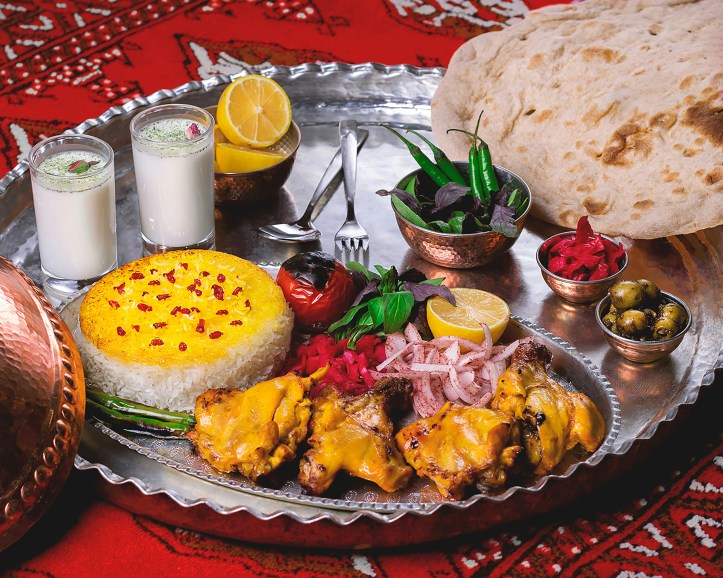
While the Iranian government’s initiative may be new, its diaspora has been using culinary diplomacy to affirm their identity and spread Iranian culture since they settled in locations such as Los Angeles (LA) in the 1980s. This affirmation of Iranian identity came at a time when Iran and its diaspora’s image was tarnished by the tensions of Iranian foreign relations in the post-revolutionary era. Paul Rockower’s concept of gastrodiplomacy,[2] which frames cuisine as a strategic tool of nation branding and cultural communication, provides a useful framework for analyzing the situation. The Iranian government’s use of gastrodiplomacy and the Iranian diaspora’s use of culinary diplomacy to redefine Iran and Iranian identity, on their own terms and on a global scale.
Background
Since the 1979 Iranian Revolution, ideological transformation and cultural tension have shaped Iran’s international and domestic ventures. The revolution overthrew the monarchy of Mohammad Reza Shah Pahlavi and placed the newly formed Islamic Republic under the leadership of Ayatollah Khomeini, signaling a sharp turn toward religious authority and straining international relations.[3] Within Iran, religious and ethnic minority communities have had to navigate the complexities of identity, loyalty, and state policy. For example, the country’s Jewish community, one of the oldest in the region, faced second-class citizenship, leading thousands to flee.[4]
In recent years, Iran has begun to pivot its public diplomacy strategies toward soft diplomacy related to foreign policy.[5] Policymakers are reimagining food, tourism, heritage, and cuisine as tools for engaging international publics and regional neighbors. As discussed in, Milk Nationalism: Branding Dairy and the State in the Arabian Peninsula, written by Natalie Koch, nations in the region have increasingly adopted branding and cultural communication strategies to project soft power and create favorable public perceptions.[6] Within this broader context, Iran’s culinary initiatives and the cultural efforts of its global diaspora represent attempts to reposition the country’s image, from one defined by revolution and isolation to one defined by cultural depth, hospitality, and regional connection.
Iran
The Iranian Deputy Foreign Minister, while on his Middle East Tour beginning in October of 2024, strategically used a form of inverse gastrodiplomacy as an entry point for each country he visited. For example, following meetings with high-ranking Syrian officials, Seyed Abbas Araghchi dined at a local restaurant on the outskirts of Damascus and later wrote on social media, “An unforgettable night in Damascus! You can find shawarma everywhere, but the authentic shawarma is from Damascus, and its history dates back more than a century.”[7] Without a doubt, the Iranian Deputy Foreign Minister engaged in gastrodiplomacy, but instead of introducing Persian cuisine to Syrian officials or the Syrian people, he ate locally and highlighted the historical importance of shawarma to Damascus.
This attempt at inverse gastrodiplomacy by the Iranian Deputy Foreign Minister created closer relations with the Syrian people by acknowledging Syrians’ contribution to a food people enjoy around the world and emphasizing the importance of eating authentic cultural foods. This venture came at a time within Syria when political turmoil was high, after ten years of civil war had led the Syrian population into crisis. Iran’s entry point was not solely focused on the governments of the countries visited: it also aimed to attract the attention of ordinary people who make up the country.
On December 8th of 2024, the fall of Syria’s regime put Iran’s gastrodiplomatic efforts to the test, forcing Iran to quickly decide how to navigate uncharted territory. As Al Jazeera noted[8] at the time, the collapse of Bashar al-Assad’s government shattered a cornerstone of Iran’s regional security architecture, leaving Tehran searching for new avenues to maintain influence and public legitimacy in the Levant. In the aftermath of the regime fall, the Iranian government framed its relationship with Syria as extending beyond formal state alliances, portraying it as rooted first in the Syrian people. This signaled that Iran valued Syria’s historical and cultural identity even as its political landscape shifted dramatically. In Syria’s fragile post-Assad environment, where international actors have competed for influence, Iran’s engagement seeks recognition as neighborly and culturally invested, not merely strategic.
Similarly, Araghchi’s gastrodiplomacy gained attention in Egypt when his visit to Cairo became a trending topic across social media. His public appreciation of Egyptian cuisine and his statement[9] that “Tehran needs an Egyptian restaurant” presented Iran as eager to embrace the tastes and traditions of neighboring nations. By inviting an Egyptian restaurant to open a shop in Tehran, the Iranian government aims to enable Iranian citizens to actively participate in gastrodiplomacy through access to Egyptian cuisine.
This approach aligns with Natalie Koch’s argument[10] that branding in the Middle East increasingly depends on “humanizing” exchanges that highlight shared traditions and social warmth. Iran’s inverse gastrodiplomacy in Egypt shows how soft power initiatives can create a foundation for empathy and cultural connection, subtly reshaping regional perceptions in Iran’s favor. Together, Iran’s culinary initiatives in Syria and Egypt show a government attempting to redefine itself on its own accord, making cuisine not simply an accessory to politics but a central tactic for rebuilding trust and expanding cultural presence.
Iranian diaspora
In contrast to the Iranian government, the Iranian diaspora engaged with food not as a tool of state messaging but as a lived, everyday practice. Shaherzad Ahmadi’s work[11] on Iranian cooking in America 1960-1979 shows how food operated as both comfort and political expression even prior to the Revolution, as Iranian women navigated questions of authenticity, modernity, and representation in their kitchens. These early culinary practices laid the foundation for post-1979 Iranian-American cuisine becoming essential to establishing belonging amid displacement.
I was able to interview Dr. M.E. who was born in 1980 in Shiraz, Iran to an Azerbaijani mother and Persian father. He moved from Shiraz to Tehran to West Germany and finally to Northern California by the age of six. Northern California, also known as the Bay area, was home to a few Persian restaurants in 1986, but nothing compared to the Persian community and food scene of Los Angeles, six hours south of the Bay area. Dr. M.E. noted that when visiting LA, Persian was no longer him and his family’s “secret language”.[12] Growing up, Dr. M.E. remembered eating Persian food regularly, and when community members threw dinner parties the food was much more sophisticated. The gatherings became a glue for a community in the midst of navigating challenges and change. The cuisine was central to the gatherings, becoming one of the few avenues for expressing Iranian identity while distancing themselves from political realities, offering a way to honor Iranian heritage without endorsing state ideology.
The Next Generation
The next generation of Iranian-American contemporary restaurant owners have expanded[13] the expression of Iranian identity into the public sphere. By moving beyond well-known dishes like kabob or saffron rice, these restaurants experiment with regional specialties and modern plating. Dishes once confined to family tables are now earning critical acclaim and even Michelin recognition. For the next generation of Iranian Americans, this reinvention is a way to connect with their roots while presenting cuisine to unfamiliar audiences, at a moment when cultural and political pressures continue to challenge Iran.
Cookbooks similarly act as tools of preservation and resilience. In 1986, Najmieh Batmanglij published,[14] Food of Life: Ancient Persian and Modern Iranian Cooking and Ceremonies, which quickly grew popular in the United States. Dr. M.E. described it as one of the “prettiest Persian cookbooks that we had seen.” The book is dedicated “To the memories of my mother and father and my past in Iran and to the future of my sons, Zal and Rostam.” Najmieh Batmanglijs’ book substantiates the idea that memory can be preserved through cookbooks. Meals like ghormeh sabzi, tahdig, and fesenjan become narrative devices through which Iranians articulate longing, negotiation, and community building.[15] Cooking embodies remembering the past and embracing the future. Just as restaurants publicly assert Iranian identity, cookbooks secure it within diaspora homes, offering both guidance and continuity amid displacement.
Taken together, the practices of the next generation of Iranian Americans mirror the broader strategies of the Iranian government: just as Araghchi’s diplomatic meals communicate recognition, respect, and cultural engagement abroad, the Iranian diaspora’s culinary practices establish continuity, resilience, and identity abroad. Through cooking and cuisine, a sense of connection is cultivated, through which Iranian soft power can be maintained and enhanced. As a result, these examples illustrate how food can operate as a tool for soft power and cultural stability, both in private kitchens or on the regional diplomatic stage.
Conclusion
Food has emerged as a critical tool in redefining Iran’s identity at home and abroad. Through gastrodiplomacy, Iranian officials strategically use cuisine to foster regional goodwill, soften political tensions, and subtly reshape regional perceptions of Iran. Simultaneously, the Iranian diaspora, particularly in the United States, engages in its own form of cultural diplomacy, using recipes, restaurants, and memoirs to preserve heritage and articulate belonging, while creating a counter-narrative to Western media portrayals that reduce the Iranian public image primarily to its political conflicts.
The intersection of these practices suggests that Iran’s global image will be shaped not only by politicians like Araghchi but also by ordinary individuals, chefs, memoirists, and families, whose daily acts of cooking and sharing food create enduring cultural impressions. These dual efforts expand the world’s understanding of Iran in an era of strained geopolitics and shifting alliances. Whether in Damascus, Cairo, or Los Angeles, these efforts offer a look into the possible near future where Iran and the Iranian diaspora will be defined by their cultural depth and regional connections rather than by conflict and isolation.
Clarke Dickens is an undergraduate student at the University of Pennsylvania. They hold a BA in Modern Middle Eastern Studies and Criminology. Their academic work centers mobility, displacement, and belonging in the contemporary Middle East, with research interests in migration and refugees throughout the Middle East and its global diasporas.
[1] WANA. “A Plate of Diplomacy.” WANA News Agency, October 23, 2024. https://wanaen.com/a-plate-of-diplomacy/#:~:text=WANA%20(Oct%2023)%20%E2%80%93%20Sometimes,been%20strained%20in%20recent%20years.
[2] Paul S. Rockower. “Recipes for Gastrodiplomacy.” Place Branding and Public Diplomacy 8, no. 3 (2012): 235–46. https://doi.org/10.1057/pb.2012.17.
[3] Roya Hakakian. “The Precarious Position of Iranian Jews.” The Atlantic, July 10, 2025. https://www.theatlantic.com/international/archive/2025/07/precarious-position-iranian-jews/683486/.
[4] Ibid
[5] Vatanka, Alex. “5 Key Factors Shaping Iran’s Foreign Policy Calculus.” Middle East Institute, May 1, 2025. https://www.mei.edu/publications/5-key-factors-shaping-irans-foreign-policy-calculus
[6] Natalie Koch. “Milk Nationalism: Branding Dairy and the State in the Arabian Peninsula.” In Branding the Middle East: Communication Strategies and Image Building from Qom to Casablanca, edited by Steffen Wippel, 185–204. Berlin and Boston: De Gruyter, 2023. https://doi.org/10.1515/9783110741100-008.
[7] Catherine Philp. “Blindsided? Iran’s Foreign Minister Dined in Syria before Assad Fell.” The Times, December 9, 2024. https://www.thetimes.com/world/middle-east/article/iran-syria-regime-assad-5mf0bd7gt.
[8] Maziar Motamedi. “What Is Iran Signalling since the Fall of Syria’s Bashar Al-Assad?” Al Jazeera, December 10, 2024. https://www.aljazeera.com/news/2024/12/10/what-is-iran-signalling-since-the-fall-of-syrias-bashar-al-assad.
[9] WANA. “A Plate of Diplomacy.” WANA News Agency, October 23, 2024. https://wanaen.com/a-plate-of-diplomacy/#:~:text=WANA%20(Oct%2023)%20%E2%80%93%20Sometimes,been%20strained%20in%20recent%20years.
[10] Natalie Koch. “Milk Nationalism: Branding Dairy and the State in the Arabian Peninsula.” In Branding the Middle East: Communication Strategies and Image Building from Qom to Casablanca, edited by Steffen Wippel, 185–204. Berlin and Boston: De Gruyter, 2023. https://doi.org/10.1515/9783110741100-008.
[11] Shaherzad Ahmadi. “Cooking Iranian Food in America, 1960–1979: The Politics of Authenticity in Revolutionary Times.” Iranian Studies, 2025, 1–24. https://doi.org/10.1017/irn.2025.10088.
[12] Interview with Dr. M.E., November 12, 2025.
[13] Sara Akhavan. “The Next Generation of Persian Restaurants Offers More than Just Kabobs.” Eater, April 21, 2025. https://www.eater.com/24410843/modern-persian-restaurants-iranian-los-angeles.
[14] Najmieh Batmanglij. Food of Life: Ancient Persian and Modern Iranian Cooking and Ceremonies. Mage Publishers, 1986.
[15] Erfan Rajabi. “Foodways and Culinary Identity in Iranian-American Memoirs.” Food, Culture & Society 28, no. 1 (2024): 287–305. https://doi.org/10.1080/15528014.2024.2312664.
References
Akhavan, Sara. “The Next Generation of Persian Restaurants Offers More than Just Kabobs.” Eater, April 21, 2025. https://www.eater.com/24410843/modern-persian-restaurants-iranian-los-angeles.
Ahmadi, Shaherzad. “Cooking Iranian Food in America, 1960–1979: The Politics of Authenticity in Revolutionary Times.” Iranian Studies, 2025, 1–24. https://doi.org/10.1017/irn.2025.10088.
Batmanglij, Najmieh. Food of Life: Ancient Persian and Modern Iranian Cooking and Ceremonies. Mage Publishers, 1986.
Cleveland, William, and Martin Bunton. A History of the Modern Middle East. Boulder, CO: Westview Press, 2012.
Hakakian, Roya. “The Precarious Position of Iranian Jews.” The Atlantic, July 10, 2025. https://www.theatlantic.com/international/archive/2025/07/precarious-position-iranian-jews/683486/.
Koch, Natalie. “Milk Nationalism: Branding Dairy and the State in the Arabian Peninsula.” In Branding the Middle East: Communication Strategies and Image Building from Qom to Casablanca, edited by Steffen Wippel, 185–204. Berlin and Boston: De Gruyter, 2023. https://doi.org/10.1515/9783110741100-008.
Motamedi, Maziar. “What Is Iran Signalling since the Fall of Syria’s Bashar Al-Assad?” Al Jazeera, December 10, 2024. https://www.aljazeera.com/news/2024/12/10/what-is-iran-signalling-since-the-fall-of-syrias-bashar-al-assad.
Philp, Catherine. “Blindsided? Iran’s Foreign Minister Dined in Syria before Assad Fell.” The Times, December 9, 2024. https://www.thetimes.com/world/middle-east/article/iran-syria-regime-assad-5mf0bd7gt.
Interview with Dr. M.E., November 12, 2025.
Rajabi, Erfan. “Foodways and Culinary Identity in Iranian-American Memoirs.” Food, Culture & Society 28, no. 1 (2024): 287–305. https://doi.org/10.1080/15528014.2024.2312664.
Rockower, Paul S. “Recipes for Gastrodiplomacy.” Place Branding and Public Diplomacy 8, no. 3 (2012): 235–46. https://doi.org/10.1057/pb.2012.17.
Stahle, Madeline. “A New Direction in Egypt-Iran Relations? Not so Fast.” Gulf International Forum, October 2, 2025. https://gulfif.org/a-new-direction-in-egypt-iran-relations-not-so-fast/.
Vatanka, Alex. “5 Key Factors Shaping Iran’s Foreign Policy Calculus.” Middle East Institute, May 1, 2025. https://www.mei.edu/publications/5-key-factors-shaping-irans-foreign-policy-calculus
WANA. “A Plate of Diplomacy.” WANA News Agency, October 23, 2024.https://wanaen.com/a-plate-of-diplomacy/#:~:text=WANA%20(Oct%2023)%20%E2%80%93%20Sometimes,been%20strained%20in%20recent%20years.
 The Oxford Middle East Review