By Maya Yamout and Dr. Steve Garner, Swansea University
I – Maya’s Story
During Maya’s fieldwork in prison in Lebanon, she experienced a profound and unsettling journey into the minds of those affected by extremist ideologies. She began researching and exploring the prison world in 2010, during her journey a few years after the rise of ISIS gained international notoriety. The turning point came in 2014, with the brutal decapitation of American journalist James Foley, an event that shocked the world and highlighted the group’s ruthless tactics. Many were firmly convinced the Islamic State would endure and potentially regain power. As part of Maya’s research for her first master’s degree, which focused on the role of social work in terrorism, she conducted numerous interviews with inmates from a variety of extremist groups like al-Qaeda, ISIS, Nusra. However, many prisoners were resistant to engage in dialogue with her or even entertain the notion of rehabilitation at first, but after a few years, things changed, and she would later earn their trust.
One unforgettable person she met was a former ISIS sniper, whom we shall call ‘Sadiq’ here. He strongly believed in the Islamic State’s permanence and sought to convince her of its unavoidable future. He took pride in his violent history, particularly his actions against the Assad regime, Yazidis, and various other groups.
In an unexpected twist, he showed up at her house unannounced in 2016. Accompanied by a driver, his sudden arrival filled her with fear. She reluctantly opened the door and let him in, driven by curiosity. He mentioned that he was set to embark on a “mission” in Syria, and when asked for more details, he simply smiled and mysteriously said, “Maya, you need to believe”. Before he left, he handed her a small black leather pouch full of coins, telling her, “See you soon in the land of Khilafa (the Caliphate)”.
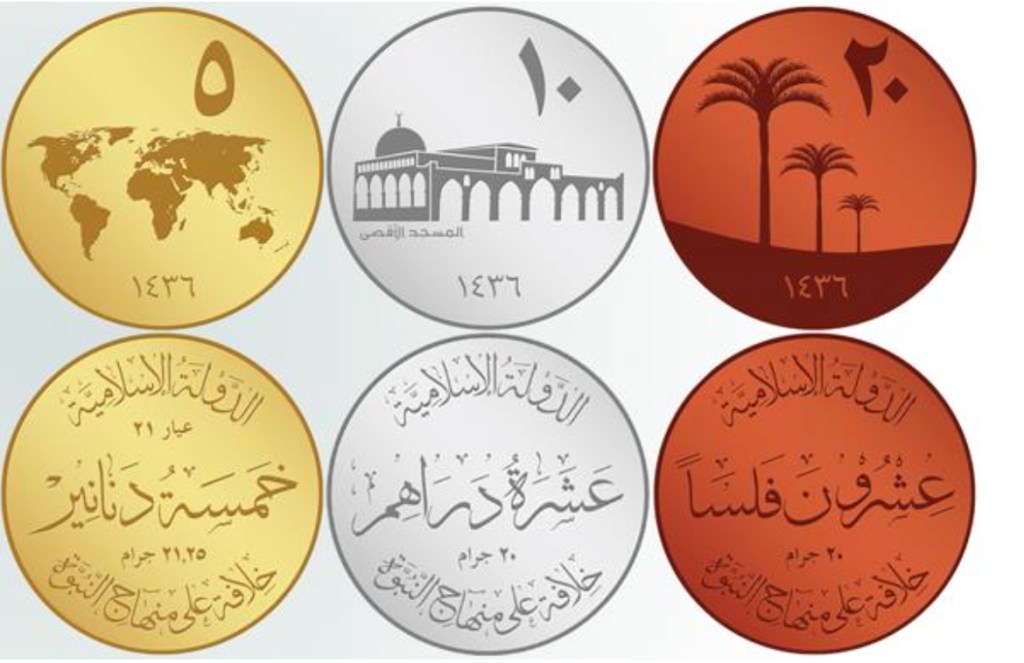
Once he left, she examined the contents of the pouch and was astonished to find IS coins. Some are made of silver (dinar), while others (fils) are made of copper. She admired their craftsmanship and grappled with many questions: What motivated them to create their own currency? Where was it minted? How did they establish a functioning economic system amid chaos? This experience caused her to ponder the complex interplay of ideology, identity, authority, and humanity’s dual tendencies toward violence and compassion.
So, we are going to try and answer her questions about IS currency.
II – What is Islamic State?
Originally created in Iraq, Islamic State emerged out of Jama‘at al-Tawhid wa-l-Jihad, led by Abu Mus‘ab al-Zarqawi in 2014 (Dhabien, 2025). Islamic State in Iraq and the Levant (ISIL) is also known as Islamic State (IS), or Daesh. The latter is an acronym of the organisation’s Arabic name. Daesh is also similar to an Arabic verb meaning “to trample on”, and as it is widely used to denote a challenge the group’s objectives and methods, we shall use Daesh for the remainder of this article. It played a major role in the Syrian civil war from 2014 until 2019. At its strongest point, in 2016, it had control of around 1/3rd of Syria and 40% of Iraq; a substantial area. It progressively began to lose this territory from 2017 up to its defeat in 2019. It currently retains strongholds in the Horn of Africa.
In Mosul, Iraq, in June 2014, Daesh leader, Abu Bakr al-Baghdadi, declared a Caliphate. Daesh henceforth sought to create and sustain a Caliphate in the territory it controlled. It specifically rejected the 1916 Sykes-Picot agreement that set a colonial border separating Iraq and Syria, among others. It therefore held territory, had an army, court system, etc. The jury is out as to whether it was ever fully a state (Mabon, 2017), but it did, nominally, have a currency, samples of which Maya’s interlocutor left her in Beirut, and which I saw when I visited Beirut in 2024. Typically, the formation of a state precedes the issue of currency (as we will see below), but in the case of Daesh, it seems to be the other way round, or at least the formation of the state was not yet complete when the currency was issued. What follows is neither an analysis of Daesh’s policies or significance, nor a commentary on Syria, Iraq, or the Kurdish question. It is more of a discussion of what makes a state a state, with Daesh’s caliphate as a case study, and what the roles of currency are.
III – What is the point of currency, and why does a state need one?
If Daesh created a currency, it was done for strategic reasons. What is the point of a currency? The simple answer is to make a trustworthy, unitary system of economic exchange. But, firstly, that is not the only function a currency performs; and secondly, that supposes a set of other factors are already in place. To have a currency that people accept and use for their in-country transactions, you need to trust it, to trust the state’s stewardship of the economy, know that other people within your defined territory share your trust, and understand that there is a legal order that punishes people who do not play by the rules of transactions.
We suggest that Daesh sought to impose its currency on the areas it controlled in order to: create the trappings of a state that holds power, legitimacy and authority, and foster national identity, which is the other function of a currency.
We have chosen our words carefully, asserting that despite having institutions and territory, Daesh was not a full state. What are the vital ingredients of a state? Mabon argues that political scientists have not reached a consensus on this question, and so it remains a grey area. The Westphalian nation-state system is based on a world of independent nations exerting exclusive power over their territory and the principle of non-interference in other states’ affairs. Such nations have people, territory under their exclusive control, authority and legitimacy, and organs of state, some of which Daesh had: police, army, courts, primary schools, and a mint. However, Caporaso (2020: 11) asserts that sovereignty involves the interaction of authority, citizenship and territoriality that comprise a state. Mabon (2017) goes on to suggest that the Westphalian model is not necessarily appropriate for other parts of the world, and particularly unrealistic when the ‘state’ is based on dividing up colonised land into new nations, using arbitrary borders. The various Western governance models may not be capable of incorporating powers resting in autonomous tribes and/or indigenous people (Bauder and Mueller, 2023), which is the case in some parts of the Middle East, such as rural Syria and Iraq. Indeed, even the term ‘Middle East’ is a term originating outside the region, deriving from attempts to demarcate the region from the Far East, and the use of the term assumed its contemporary form in the early 20th century. All this to orient us to the possibility that what a state is in one place might not necessarily comply with what a state is elsewhere. The continued normalisation of the Westphalian model is due to the power relations extant since the 17th century, where European and North American economic and military power has dominated.
According to the nineteenth century Westphalian nationalist formula, people + territory = nation. But of course there are anomalies anyway (even if we forget that most nations are multicultural in some way. It is possible to have people without a state (e.g. Kurds, Tamils, Palestinians) or a state without its own specific currency (all the Eurozone nations and certain other European states which use the Euro without EU membership, plus others where the US dollar is a joint currency, such as Panama, El Salvador, and Ecuador). Separatist nationalist movements that don’t care about having a national currency as part of their programme (e.g Quebec) exist as do, albeit much less frequently, those that create a currency without a state … which may be the case with Daesh.
So how do we grasp what’s relevant here given the contingency of what makes a nation? The key point is explained by Papadopoulos (2015), who maintains that you cannot have currency without political authority behind it. And political authority includes trust, legitimacy, and stable borders. For enough trust that the state is going to be a solid steward of an economy to accrue, that authority has to function. If borders are unstable, the territory under control cannot be stabilised and the rules decided upon in the centre cannot be effectively applied everywhere. What stake would people have in a new currency, for example, in an area that was changing hands in war time – which is precisely the case of Syrians and Iraqis (plus thousands of foreign fighters opposed to Daesh) living on the fringes of Daesh-held land between 2014 and 2019. If people are coerced by force (outside of the state’s legitimate monopoly of violence) into accepting the authority, that also precludes legitimacy from being normalised, and legitimacy is part of the puzzle of currency doing its job. Indeed, the Syrian revolution itself began as resistance to the state exceeding its threshold of acceptable violence (Sakhi, 2023), so that issue was prominent when Daesh held territory there. Put simply, Daesh did not control enough of its territory effectively enough, or for long enough to establish authority and trust required to embed the use of a new currency. Added to this, many of its people were not willing Daesh subjects, despite the various stability-seeking policies implemented, and this prevented them from establishing legitimacy. Ultimately the conditions for introducing a functioning new currency were not satisfied.
IV – What did producing currency mean for Daesh and what messages did it convey?
If that is the case, we need to figure out what the point of producing currency was and maybe get closer to why Sadiq used the coins as symbols in his last interaction with Maya.
It is therefore probably more instructive to look at how Daesh currency is an attempt to establish and sustain a national identity. Helleiner (1998: 1409) sets out five ways currency helps foster national identity. Four of these depend on the state’s authority to establish and disseminate trustworthy information, which should show us the limitations of the Daesh currency, [1] but the first of these is useful:
“Providing a vehicle for nationalist imagery that constructs a sense of collective tradition and memory”.
The nation envisaged by Daesh is anchored by a desire to link control of territory to the values of Islamic currency and further emphasise continuity between past and present, in which the state controls particular areas of activity, all whilst indicating a shared future. All of this is, of course, under the identity of the Caliphate, identified in the inscription upon all the coins, which reads: “Caliphate of the Islamic State. On the path of the Prophet” (Lokmanoglu, 2020: 59).
Ideology
Daesh make a distinction between value of coins and paper money on the gold standard, which links back to Ibn Khaldun’s Muqaddimah (1377) (Weiss, 1995; Krichene and Ghassan, 2019). He was a proponent of gold and silver coinage because it promoted stability, retained value, and indeed the currencies of early Muslim caliphates had been based on gold and silver. The nomenclature of the Daesh coins points us directly toward such a legacy: fils (copper), dirham (silver) and dinar (gold) link the past to the present and the future [2].
Moreover, Daesh strongly advocates the values of such currencies not only for economic stability, but because embracing (Western) paper currencies they describe as “… ‘corrupt’, ‘interest-based’ and ‘manipulated'” (Lokmanoglu, 2020: 64) demonstrating a central moral flaw in their adversaries, such as the Gulf States, Iran, and Iraq. We are not, they argue in this choice of currency, Persians, Shi’a or Western-backed Sunni Muslims, but remain true to the values of the ancient Caliphates: as it states on the coins, “on the path of the Prophet”.
The representations on the coins are of standard areas of state activity, such as trade, agriculture (fields), war (spear and shield), palm trees and statehood (Lokmanoglu, 2020: 62), also featuring the Umayyad Mosque (in Damascus). However, the community over which this future state holds control should bear some scrutiny. The references to the past identify Daesh’s citizens as a community of fate, as in the classic Western ideas of nation expressed by Ernest Renan, in Qu’est-ce qu’une nation ? (1892):
“To have common glories in the past and to have a common will in the present; to have performed great deeds together, to wish to perform still more – these are the essential conditions for being a people”.
Although the emphasis Daesh places on continuity with the past and even recapturing lost unity, is classic nation building and “invention of tradition” (Hobsbawm and Ranger, 1983), the breadth of the community is not as great as suggested. The authentic Islamic community as understood and managed by Daesh is not particularly wide. There are two very important distinctions within their understanding of the Islamic community. The one specifically in the Middle East context (Mabon, 2017) between Arab and Persian, and that between Sunni and Shi’a. Daesh favours the former in each case, seeing the latter as heretics. The highest concentrations of Shi’ite Muslims (the overall minority in the Islamic world) in the region are resident in Iran and Iraq. Since its formation, Iraqi Sunnis have led the organisation. And within Daesh, investment in the project is very different for the four categories of resident that Mabon identifies: elite, governance, fighters, and enticed / coerced.
Daesh’s coercive practices in the Islamic State (2014-19), aimed at the latter of these categories, generated collective loyalty principally by fear. Identities were subject to surveillance and multiple controls, such as those on the movement of foreign fighters and the destruction of their passports on arrival, as well as punishments meted out for criminalised activities (Mabon, 2016: 975-80).
Moreover, apart from Daesh’s tenuous control over their territory and highly uneven levels of loyalty from the territory’s residents, the currency was barely used. The online world was the only place that this currency is even theoretically equivalent to used currencies. Lokmanoglu contends that there is “no public evidence apart from eBay memorabilia” that Daesh even minted coins (2020: 57). However, as Sadiq had some, we can assume there was a distribution of them among fighters and loyalists. While the propaganda film Lokmanoglu studies seeks to make the use of the currency an ordinary, everyday thing (2020: 62), it was anything but that.
So, the currency represents an aspirational nation with an aspirational state. Of the two projects, the latter was further developed, with various organs such as an army, courts, and governance strategies. However, the nation was largely unconstructed, and so its symbolic presence – the currency – carried aspirations that could not be satisfied. Even though it at one period held a lot of territory, Daesh was relentlessly beleaguered by external and internal military pressures, which made its borders permanently vulnerable and protean, and resulted in problems of imposing belonging on unwilling people. The violence and coercion it deployed made unappealing to many Syrians. Thousands of ordinary people there had participated in a huge protest movement or even taken up arms against the authoritarian and vindictive rule of Bashar al-Assad’s Baath Party before Daesh emerged as a serious actor. Its coins thus supposed an order and stability that never corresponded to the actual conditions in which IS was trying to make a nation-state.
V – Conclusion
Daesh never had control for long enough to develop the political authority and legitimacy essential for a national currency to be trusted and used. Daesh never managed the economy of the entire territory they controlled at a given point, and any loyalty it accrued was not through ensuring the ordinariness and safety that most people crave (although in the context of the war, from 2014, they did originally provide security in some areas). The national identity it wanted to create was only symbolic, in that only a few Daesh insiders and foreign fighters definitively bought into it. Its online presence (Lokmanoglu, 2020) was as far as it got, with coins minted seemingly as pilots/samples, symbolising the faith and hope its adherents had for future expansion and above all consolidation of the State, with films made to show people using the currency. If Daesh was aiming at a much more ambitious project than Iraq and the Levant, as implied by their choice of title, then this would have been an important phase of conquest and building. The currency plays a role in that construction process. So, Sadiq’s provocative ‘gift’ of coins to Maya can thus be read as a statement of intent, of faith in a project, a way to resist the status quo to which Daesh was opposed, and at the same time, an act of intimidation: all of which are part of the story of Islamic State.
[1] The other four are: ‘Acting as a common medium of social communication that may facilitate the ‘communicative efficiency’ of members of the nation and encourage similar frameworks of thought; Creating collective monetary experiences that can bolster the feeling of membership in a national community of shared fate; Contributing to a sense of popular sovereignty (at least insofar as the national currency is managed in a way that corresponds with people’s wishes); Strengthening the kind of quasi-religious faith that is associated with nationalism, especially when the currency is managed in a stable manner’.
[2] The three subdivisions of the IS currency all have their roots in Mediterranean coins from the second half of the 7th century, very early in the life of Islam. The fils (pl. fulus) was a medieval copper coin first produced by the Umayyad Caliphate (661–750); the dirham, based on the Greek drachma, became an Islamic currency using silver, from the late 7th century. It is the current currency of Armenia, Morocco and the UAE. The dinar (from the Latin denarius) was introduced by Caliph Abd al-Malik ibn Marwan (696-697). Both dirham and dinar are referenced in the Quran and endorsed in it by the prophet Muhammad.
References
Bakkour, S. and G. Stansfield. 2023. ‘The Significance of ISIS’s State Building in Syria’ Middle East Policy 30(2): pp. 126-145
Bauder, H. and Mueller, R. 2023. ‘Westphalian vs. indigenous sovereignty: Challenging colonial territorial governance’. Geopolitics, 28(1), pp. 156-173.
Caporaso, J.A. 2000. ‘Changes in the Westphalian order: Territory, public authority, and sovereignty’. International Studies Review, 2(2), pp. 1-28.
Cohen, B.J. 2013. ‘Currency and state power’, in Back to basics: State power in a contemporary world, Finnemore, M., and J. Goldstein (eds), Oxford: OUP, pp. 159-176.
Dhabien, O. 2025. ‘The Centrality of Iraq and Syria to the Islamic State’s Caliphate’ Jihadica, 13 February: https://www.jihadica.com/the-centrality-of-iraq-and-syria/
Helleiner, E. 1998. National currencies and national identities. American Behavioral Scientist, 41(10), pp. 1409-1436.
Hobsbawn, E, and T. Ranger (eds). 1983. The Invention of Tradition Cambridge: Cambridge University Press.
Krichene, N, and Hassan B.G. 2019. ‘The Preeminence of Gold and Silver as Shariah Money’, Thunderbird International Business Review Vol. 61: pp. 821-835: https://mpra.ub.uni-muenchen.de/95445/
Lokmanoglu, A.D. 2020. Coin as imagined sovereignty: A rhetorical analysis of coins as a transhistorical artifact and an ideograph in Islamic state’s communication. Studies in Conflict & Terrorism, 44(1), pp. 52-73.
Mabon, S. 2017. Nationalist Jāhiliyyah and the Flag of the Two Crusaders, or: ISIS, Sovereignty, and the “Owl of Minerva”. Studies in Conflict & Terrorism, 40(11), pp. 966-985.
Papadopoulos, G. 2015. Currency and the collective representations of authority, nationality, and value. Journal of Cultural Economy, 8(4), pp. 521-534.
Renan, E. (2001 [1892]) Qu’est-ce qu’une nation ? Revue bleue, 1, p. 106.
Sakhi, M. 2023. La Revolution et le djihad : Syrie, France, Belgique Paris : La Découverte
Weiss, D. (1995). “Ibn Khaldun on Economic Transformation”. International Journal of Middle East Studies. 27 (1): pp. 31–33.
 The Oxford Middle East Review