By Eva Morgan, University of Oxford
Iran grew closer, and a group of women started to unpack loose black garments. Astara, like all of Azerbaijan’s land borders, allows exit only – no entry from the Islamic Republic of Iran. The thick, black line divides more than national boundaries. International ideologies face off, as secular, Israeli-allied Azerbaijan is a counterweight to the Islamic Republic of Iran. This government-enhanced binary is almost convincing on a map. However, the misty, forested mountains stretching ahead of the spluttering bus pay little attention to the checkpoints. Neither does the history of their inhabitants the Talysh, whose cross-border legacy blurs of the geopolitical binary.
Talyshistan, as the area is known by some, stretches from the Aras river in the south of the Republic of Azerbaijan to the Sefid-Rud river of Iran’s Gilan province. In other words, the Talysh community has been split by modern borders – half in Azerbaijan, half in Iran. Linguistically, culturally, and ethnically closer to old-Iran and Persian, the Talysh do not fit into a national promotion of a Turkic identity. “Talysh” was first mentioned in an Armenian translation of the Alexander Romance, and the Talysh Khanate existed cross-river until division in the Treaty of Gulistan in 1813 by Russia. In the south-east corner of the country, the community’s existence offers a counter-narrative to supposed ethnic borders drawn along political maps.
Three kilometres from the border, I stick up my hand and jump out the minibus. Having nearly emptied at the bus station in the majority-Talysh city of Lankaran, only a few are left in the battered vehicle which left Baku full. Anar (from the homestay) and a small Soviet-era taxi meet me, and soon we are headed towards the Talysh village of Sym. Infrastructure is under-developed, and the 20 kilometres through Hirkan National Park takes just over an hour along unsurfaced road. Azerbaijan’s history is as a crossroads occupied by the Ottomans, Persians, and Soviets, as well as local, jigsaw empires. Talysh’s warm and rainy climate is a magnetic economically, important region for fruit, vegetable, tea, and grain production. Yet, while attracting empires, the Talysh mountains provided a cultural bubble difficult to penetrate, and Talysh culture remains distinct. The same mountains that shelter the region’s last Persian leopards also stalled the Safavid’s Shi’ite expansion southwards, and Sunni Islam remains, all be it in a local form.
Sym is a village of Talysh speakers, yet Azerbaijani is the language of schools, local government, and media. Anar’s family speak a mix of languages: Anar’s mother and sister speak Talysh and Azerbaijani, Anar additionally English, and his father additionally Russian. For his father’s generation, Russian was compulsory in school and near essential for work during the Soviet Union. Despite changing ideologies, a commonality is a lack of Talysh in the media, schools, or workplaces. Overshadowed by fear of Iranian Empires, all three overseers promoted a European, Turkic counter-identity, which by proxy alienated those with Iranian ethnic and linguistic lineage. The motto of the founder of the First Republic of Azerbaijan, Muhammad Amin Rasulzade, was “Turkify, Islamisize, Europeanize”. Debates over “Azerbaijani” vs “Azeri” are themselves connected to an ethno-linguistic search for justification of a “true” Turkic identity through selective history. According to media outlet Eurasia Diary, “Azerbaijani” is Turkic, linked to the ancient Turkic “Az” tribe but “Azeri” linked to the Azeri Iranian tribe, and allegedly a term promoted by the Soviets to de-turkify Azerbaijan.
The Russian-empire openly pursued a de-Iranianisation policy during their Caucasus expansion under Peter the Great between 1722 and 1735. The Soviet Union continued, removing Talysh as an option from the census and identity cards, pressuring ethnic minorities to register as Azeri to enter the mainstream job market. The USSR’s splintering gave the Talysh a drive for independence, which culminated in the declaration of the short-lived Talysh-Mughan Autonomous Republic in 1993.
Mountains carved differences of identity between Turkic Azerbaijani’s and the Talysh communities. The hills simultaneously provide privacy, allowing culture to develop largely insulated from external neighbours. Religion clearly shows this organic growth. Customs develop which may differ even village to village, and Islam is closely compatible with the Talysh style of daily life. The small villages scattered among the mountains have no local mosque, and Anar’s phone plays the call to prayer. Anar says most villagers only pray if they are inside, as the rainy environment is hostile to stopping too long outside. Instead of a hijab, some women wear a colourful headwrap, others without. Amid a hazy drizzle, a funeral procession for a local man takes place, with a special place for his favourite dog to watch, and the village’s black clothes are interspaced with bright headwraps. Religion plays a background, softer, cultural role in the village, Anar says.
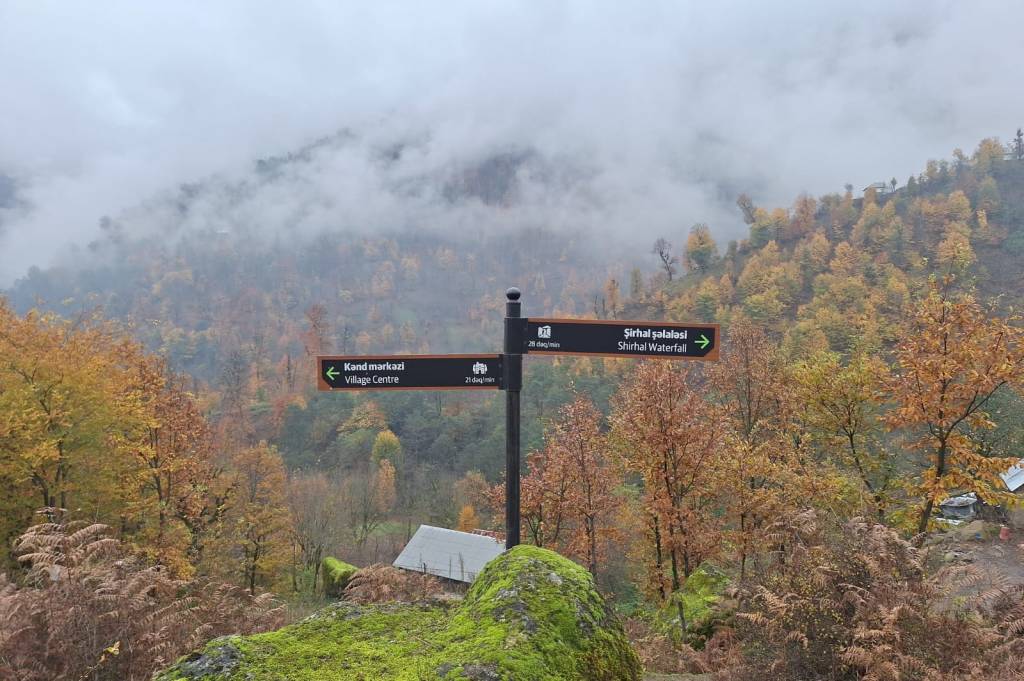
White and wooden houses peak out from trees dripping in autumnal reds, oranges, and greens. Chickens, turkeys, cows, and dogs wander, despite the constant rain. Less evident is infrastructure development. Azerbaijan has significant natural energy reserves, yet a lower GDP than its resource-poorer neighbour Armenia. The road linking Sym to the coastal dual carriageway is unsurfaced and dangerous in rain, and the only real sign of government money is in shiny new tourist signs. However, the home I am staying in displays an EU sign, announcing sponsorship for touristic development in Azerbaijan. COP-29 brought an spotlight on Aliyev’s crackdown on media and civil society organisations. In 2024, Freedom house defined Azerbaijan as a “consolidated authoritarian regime” with a score of 1 out of 100, while Reporters without Borders ranked Azerbaijan 164 out of 180 for press freedom. However, the EU and Azerbaijan’s relationship continues to grow warmer. The EU-Azerbaijan Partnership and Cooperation Agreement was signed in 1999 and updated in 2017. Sanctions against Russia prompted by the Russian invasion of Ukraine further enhanced Azerbaijan’s standing as an alternative source of oil for Europe, as the start of the Southern Gas Corridor to Italy via the Caucasus, Bulgaria, and Greece.
In fact, the stark boundary between Azerbaijan and Iran, which the Talysh live across, fuels Azerbaijan’s growth as a global middle power. Iranian-Azerbaijani relations are turbulent, with friendly and hostile spells. Iran was one of the first countries to establish full diplomatic relations with Azerbaijan, yet was seen to have sided with Armenia during the first Nagorno-Karabakh War (1988-1994). Responding to growing tension, anti-Iranian countries saw an opportunity to craft Azerbaijan’s army into a key front against Iran, such as a $5 billion defence deal with Israel in 2012, which delivered 66% of Azerbaijan’s arms between 2016-2023. Yet, Azerbaijan remains working with Iran sporadically, primarily in infrastructure and energy investments. February 2025 brought Aliyev’s announcement of a desire to modernise transport links with Iran, building on financial investment into an agreed connection of Iranian, Azerbaijani, and Russian electricity grids in 2018. Astana, the border-crossing near Sym which was closed in 2020, was opened for foreigners fleeing Iran during the recent Iran-Israel conflict. However, Azerbaijan’s miraculous partnerships across almost the entire political spectrum may be splintering, as Israel’s war in Gaza causes friction between Turkey and Azerbaijan. Oil shipments to Israel were removed from Azerbaijan’s customs register in January 2025, potentially due to pressure from Turkey.
Despite being developed as an ideal proxy for anti-Iranian countries, foreign investment has had the effect of making Azerbaijan more independent, not less. Unlike Ukraine and Georgia (annexed regions of South Ossetia and Abkhazia), growing military strength has allowed Azerbaijan to move out of Russia’s direct sphere of influence, such as pushing for an international body to oversee the Zangezur corridor between the mainland and Nagorno-Karabakh instead of previously arranged Russian soldiers. COP-29 brought the world to Baku, which strengthened Azerbaijan’s global authority, and hosting fleeing foreigners from Iran won Aliyev favour from a spectrum of countries. Azerbaijan is benefiting from all sides, currently considering joining the Abraham Accords and aiming to improve relations with America via Israel, while being won over by China as a link in the Belt and Roads Initiative in April 2025.
Yet, compared to Baku’s Dubai-like glass high-rises and COP motivated shine, Azerbaijan’s growing success is not being financially filtered down to the Talysh community. In the modern fight for soft power through investment, money speaks volumes. For Sym, the European Union is a bringer of money to an otherwise resource-poor region. The definition of soft power, Europe is positively thought of just three kilometres away from Iran. Sustainable, community tourism is allowed by a one-off investment. The family I am staying with have electricity, internet, and a hot water boiler – unlike most others in the village -, which is what allows them to operate as a homestay for tourists. Tourism, which comes particularly from Russia and from hikers, is also incentive for young people like Anar to stay in rural communities, rather than moving to cities for greater economic opportunity. Indeed, the growing importance of tourism to Azerbaijan is shown by the new government-funded signs posted, slightly incoherently, around the village. Sym’s fabled mystery stones, eagerly advertised by these signs, reputedly date back to a period of cultural importance around the 7th century.
Both governments and the international community need the Azerbaijan-Iran border to seem binary, a watershed between “oppression” and “freedom”, “ally” and “enemy”. The Talysh blur this binary. This artificial bid to suppress nuance in the name of national security, however, threatens the loss of a fascinating and beautiful culture.
 The Oxford Middle East Review