Farrell Gregory, Foundation of American Innovation and the University of Oxford
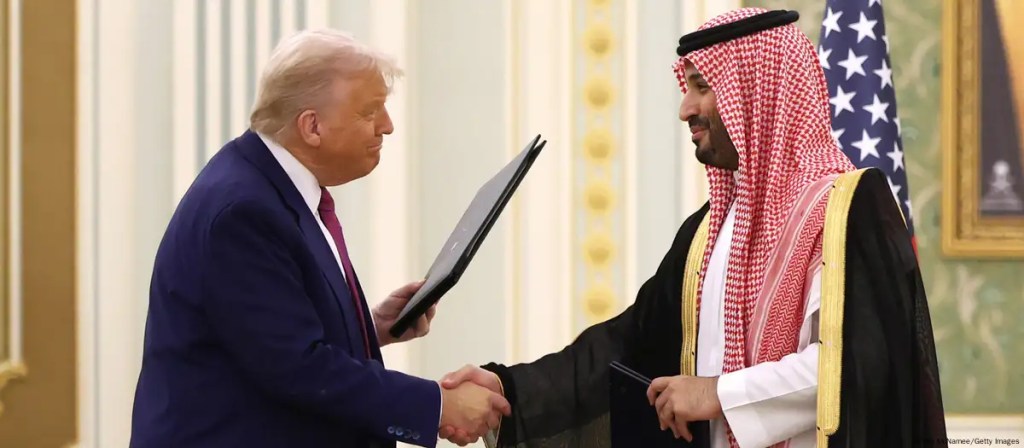
In his recent state visit to Saudi Arabia, President Trump articulated his vision for the Middle East: “commerce, not chaos”. This brief description points to an emerging reality: Riyadh and Washington’s partnership is shifting, increasingly based on shared commercial interests and a grand strategy for regional security. President Trump used this visit to Saudi Arabia, Qatar, and the United Arab Emirates to solidify and attempt to implement that strategy.
Trump’s trip to Riyadh came at a time particularly suited to dealmaking. With his tariff policies, President Trump is allegedly making a concerted effort to reorder America’s trade dynamics and domestic production capabilities. Meanwhile, Saudi Arabia is pursuing its own economic diversification plan: Saudi Vision 2030. Shifting away from a historical reliance on oil production, Saudi’s Crown Prince and Prime Minister Mohammed bin Salman is seeking to reorient the Kingdom towards tourism, finance, entertainment, and advanced technologies. These incentives point towards increased bilateral investment between the two partners. During the trip, President Trump signed a record-breaking package of $600 billion in investment commitments from Saudi Arabia.
These investments could lead to collaboration on critical mineral access and processing, a shared concern for both. The United States, which is highly reliant on China for critical minerals to build weapons and commercial products, supplies Saudi Arabia with 80 percent of its weapons. If America loses access to these essential inputs, a real risk considering China’s recent export controls on certain heavy rare earth elements, this imperils Saudi Arabia’s weapon supply chain.
To ensure mutual access to raw and refined minerals, Riyadh and Washington could pursue two collaborations. First, building on existing discussions, the two countries may announce a joint financing mission to purchase sensitive mines and undeveloped deposits. Such an agreement would allow Saudi Arabia to utilise its financial flexibility while allowing the U.S. access to future equity or extraction rights. Second, U.S. and Saudi officials could agree to invest in raw material processing capacity within Saudi Arabia. As part of a larger effort to decrease reliance on Chinese industry, Saudi Arabia’s low energy costs, regulatory adaptability, and geography would make it a suitable location for such a capital-heavy endeavour. This arrangement is already beginning to take shape: during the trip, the Saudi state mining company Maaden and MP Materials, a U.S. company, signed an agreement to develop a rare earth supply chain in Saudi Arabia.
Trump’s visit also resulted in $142 billion in arms sales, a record-breaking number that stands in sharp contrast to the Biden administration’s policies. But Riyadh’s own desires are likely to go beyond what is already on the table. In addition to the possibility of American assistance in developing a domestic civilian nuclear programme, Saudi officials are likely to push for more advanced weapon platform sales, such as the F-35 fighter jet. After the Biden administration’s temporary block on all weapon sales to Saudi Arabia, they may want to make up for lost time and capitalise on a collaborative relationship with the Trump administration.
These aligning interests undergird a larger point about America’s role in the Middle East. By developing productive ties to regional powers like Turkey and Saudi Arabia, the U.S. will likely pursue a policy of relying on military partners to ensure stability and allow America to rebalance its own security commitments. Elbridge Colby, now the Under Secretary of Defence for Policy, once wrote that to balance power with allies in the Middle East “with relatively little effort, given its enormous advantage in power, the United States can encourage and help sustain such a coalition”. [1]
For President Trump, this would require an expansion of the Abraham Accords, a success of his first term that led to the normalisation of relations between Israel and the United Arab Emirates (UAE), Bahrain, Sudan, and Morocco. Bringing Saudi Arabia into the fold will likely be a high priority for the administration, during this visit and over the next four years. Although such an agreement would likely be difficult to negotiate, and would certainly require compromises on both sides, Saudi Arabia has already demonstrated a growing interest in regional diplomacy over the last several years. In 2023, it allowed China to mediate an agreement for the normalisation of relations with Iran. In 2024, Saudi Arabia signed a military cooperation agreement with Iraq. More recently, Riyadh hosted a visit from the new Syrian leadership and peace talks involving Ukraine and the United States.
So far, President Trump’s Middle East policy has favoured diplomatic exchange over conflict. The U.S. and Iran have undergone five rounds of nuclear negotiations and the two sides seem to be making progress. Similarly, President Trump announced in Saudi Arabia that the U.S. would lift sanctions on the new government in Syria, and in his words, “to give them a chance at greatness.”
It appears that Trump’s grand strategy in the Middle East is to maintain productive relationships with autonomous regional partners in pursuit of relative stability. Rather than trying to dictate development from Washington, it is in America’s interests for states in the Middle East to develop their economies and build up their own states peacefully. That peace would allow America to focus on its own military interests: rebalancing security commitments towards the Indo-Pacific. In the Middle East, Saudi Arabia would play an increasingly large role as a regional power and leader in technology and finance.
Listening to President Trump’s speech, his description of Saudi Arabia’s development is strikingly similar to his vision for America: “Peace, prosperity, and progress ultimately came, not from a radical rejection of your heritage, but rather from embracing your national traditions and embracing that same heritage”. This insight is the foundation of the new Saudi-America alignment: America and Saudi Arabia are pursuing common goals well beyond counterterrorism. Autonomy, regional leadership, and mutually beneficial development are the best ways to achieve them.
References:
[1] Elbridge A. Colby, The Strategy of Denial: American Defence in an Age of Great Power Conflict (New Haven: Yale University Press, 2021): 35.
 The Oxford Middle East Review